Did you see the “blood moon” this morning? I hope so, because it was beautiful. I don’t
have a tripod, so taking night photos is difficult at best. I did manage a photo when the moon wasn’t yet
in full eclipse, just before it dipped behind the trees.
For once, I wasn’t battling rain or clouds or even antsy
dogs who can’t stand still. Just before dawn four or five deer joined me near
the snowmaking pond. They were
interested in getting an early morning drink and were content to ignore me,
even as I ignored them while the eclipse was taking place. I can’t remember the
last time I got to see a full eclipse, though I know it’s been quite a
while. Several have occurred during
cloudy weather and others simply weren’t visible here. This time, though, none
of those things occurred, and the sight was one to remember.
Wednesday, October 08, 2014
Monday, October 06, 2014
Nell's Hill, early fall
![]() |
| Nell's Hill with the start of fall color |
Although I can’t yet see this mountain from my cabin, at
sunset I can now see where the bright sky ends.
As that is where the outline of the mountain begins, I know the mountain
will reappear at my western windows soon. Slowly, ever so slowly, the holes in
the forest’s leafy canopy grow larger, and my view of the sky overhead of my
abode is opening, a little bit at a time.
This weekend brought a small taste of the cold weather
ahead. I didn’t have a frost but it was close, and I suspect the lower-lying
areas at the foot of the mountain might have had one. Higher up on the
mountain, where I live, temperatures are more moderate than down lower. The average date of the first frost here is
October 13, so that’s not far off.
It’s cold enough now that I’ve added more straw to the
chicken pen, and I find that several cats suddenly want to sleep with me. I didn’t turn my heat on this weekend when
the outside temperature dropped, though it was chilly enough that I was tempted
to. I decided to wait it out, knowing that this early cool snap would moderate
in a few days.
Thursday, October 02, 2014
Reddish dawn
Dense fog covered the mountain early this morning, though
began to rise at dawn. The result
created a very pretty and unusual sunrise. I had to stop and watch it for a
while, nearly making myself late for work, but what is work against a sunrise
like this one?
This was not the "red sky at morning" kind of dawn that heralds a storm. This was simply the sun rising through a layer of ground fog, but the timing of the mist rising with the sun making its first appearance was perfect.
I've lived more than 60 years now and have never seen a sunrise quite like this one. It's true that each is different, but some, like this one, are unique.
Delicate reddish mist rising over the eastern mountains,
alternating with dawn’s red sky and purple clouds nearly matching the color of
the morning mountains. It’s a rare sunrise
indeed and not to be missed because of work.
Wednesday, October 01, 2014
Auction day!
Now that my family’s auction is over and I am largely
recovered, I will share a few photos from the event. I intended to take a lot of photos, but the
day was too busy to be pointing a camera too much. I took most of my photos before the action
became fast and furious.
My siblings and I have been working towards this sale for
the better part of a year. Neither my
grandparents nor my parents ever had sale when the previous generation passed,
so that task fell to the three of us.
Worse, my parents, children of the Great Depression and World War II,
never threw anything away. And I do mean
anything. We found receipts from 1970
and check stubs from long-ended jobs of 40 years ago. Naturally, good things were mixed in with the
junk, so we had to go through everything very carefully and couldn’t just toss
it first.
But finally, we were as done as we were going to be, and it
was time for auction. We sold old things
and new, farm implements you’d have to be a bodybuilder to lift, household
items—all manner of things. We had family and antique dealers, friends and
strangers attend. The day was gorgeous, and we had a decent turnout, if not
quite the standing room only crowd we might have hoped for. With 50 other sales
in a 30-mile radius, buyers were spread a tad thin.
One of the things we sold was the old buckboard wagon, which I loved to sit in as a small child. The man who bought it plans to restore it, though he expects that's a 4-5 year project. He will enlist some Amishmen to replace the wood around the iron wheels. He tells me that alone takes 3 months per wheel. I'd like to see it again whenever it's done.
Still, the event was a nice success for the
family, and the house and old barn are now a lot, if not entirely, empty. There’s still more work to be done, though no
deadline looms over our heads to accomplish that. Now, we can go through the
mountains of photos we want to digitize and identify as many ancestors as we
can. We also have a lot of old documents
that we need to examine and figure out what to do with, since starting a family
library the way former presidents do is probably not going to happen.Tuesday, September 30, 2014
Autumn's progress
The autumn color change is underway in a few areas on
Roundtop Mtn. In the lower, cooler spots
along a stream or a run, gold and yellow leaves are beginning to be
evident. Higher up, where I live, the
trees are still green.
Some leaves, though not many, have already fallen,
decorating the mountain lane with a bit of color. As yet, this is not enough to
open up the leafy canopy and extend my visibility. Leaf fall is often a slow process, especially
at the beginning. However, I’ve had nearly 6 months of studying every tiny hole
in the canopy around my cabin, so by now I know it well and am ever vigilant
for the slightest change.
I am at least 3 weeks away from the main leaf fall and
probably longer. When I first moved to
the cabin, some 20 years ago, the main leaf fall occurred in late October. But as climate change has progressed, it now
happens in early November, once as late as November 11 but more reliably around
November 5-7, at least for the last few years.
Still, by late October the canopy is much opened again, just from the
leaves that fall earlier than most of them.
As the season progresses, leaf fall is lot like
a continuous snow flurry, cascading off the trees to cover the forest floor
until they are shin-deep in some places. On a day when many leaves drop,
walking through the forest is a lot like walking in a falling snow. Falling leaves make a gentle rustling sound,
best heard when surrounded by a forest.
The effect is not the same with just one or a few trees. When the whole forest is “molting” the sound
is similar to the sound of wind through the trees in summer, but with a drier tone. I love to walk through the forest and feel
the leaves falling all around me, making that lovely fall sound. It’s best heard on a day without wind, but as
long as the breeze is a mild one, I can still hear the leaves when they fall.
Thursday, September 25, 2014
Rainy fall morning and weekend auction
![]() |
| The calm before the auction |
This is the kind of day when I keep the chickens in their pen, at least until noon. Nighttime predators stay out often well past dawn on rainy and dark, overcast days. I guess the hunting is better for them once the daytime animals appear. The predators seem to be able to tolerate daylight (or what passes for daylight on a dark morning like this one) as long as the sun is well hidden. In the past, before I paid attention, I’ve lost chickens to a fox and a raccoon, both foraging well past the time they are usually in their dens for the day.
![]() |
| Sparrow checks out some of the goods! |
Today my photos were taken at my family’s farm. After a year’s work, we are having an auction of the contents this weekend. Neither my parents nor my grandparents ever had sale when the previous generation passed, so we have a lot of stuff. I’ve been amazed at just how heavy those old iron farm implements are. Some I can barely lift, let alone use or manipulate. Those oldtime farmers must have looked like body builders!
Monday, September 22, 2014
What the wind brought
Today’s northwest breeze is pushing a lot of migrants
southward. I’ve seen Broad-winged Hawks
and Black Vultures, as well as flocks of 20-25 little somethings that are too
small or too distant to identify. Waterfowl
will be appearing soon, though I haven’t seen any flocks of those yet. The first week of October is about right for
their migration.
The wind brought down a very large, dead limb not 10 seconds
after Skye and I walked past that spot.
The limb was light because it was dead and pretty much hollow but it
still may have been deadly if we’d been struck.
I heard it crash through the lower part of its tree when it fell but
knew instantly it was far enough away that we would be safe. I’d like to think
that had I been underneath it, that crack would have alerted us and given us
enough time to get out of its way. I’m not sure that’s the case, but I’d like to
think so. Skye set up a ferocious
barking at the downed limb, which was curled and coiled like some large, if
stiff, snake. It was fortunate the limb
was as light as it was, as I had to move it to get the car back out of the
driveway.The small annual plants on the forest floor are really fading now—turning color or just disappearing onto the ground. Some tulip poplar leaves have turned color and are beginning to litter my driveway. Most of my houseplants are now inside, and the rest will need to come in tonight. Tonight the temperature will drop into the lower 40’s and that’s just too cool for a houseplant.
Friday, September 19, 2014
Bird Buffet
![]() |
| Pokeweed |
This morning a blue jay was being chased from the tree by a small bird that was too fast for me to identify. A little bit higher I saw an immature black-throated green warbler, but they are insectivores, not herbivores, so it wasn’t that little beauty. It’s possible the warblers were gathering insects on the plant and didn’t take kindly to a nearby blue jay, but I don’t think it was that bird.
Pokeweed is largely toxic to humans, though various parts of it are edible, at least at certain times of the year. I’d have to be pretty hungry before I attempted it, though. The plant is not toxic to birds and is in fact something of a bird magnet. I’m already planning to “plant” myself near here sometime over the weekend to see what else shows up at this bird buffet.
Thursday, September 18, 2014
Early morning
![]() |
| Ready |
The sound of great horned owls, the higher-pitched female and the basso profundo of the male, echo across the forest before dawn’s first paling. They call back and forth to each other, one further up the hill than the other.
The last hour before daylight and the first hour of night is when they are most active and most vocal. I have lived on this mountain for more than 20 years now, and their presence has been a constant, though I have rarely seen them.
When I have seen them, it has nearly always been on a dreary, dark morning, when an overcast sky tempts them into staying out later to hunt for prey. When that happens, crows may already be up and spoiling for a good early morning mobbing of the predator. Sometimes, they meet up with another nemesis, the red-tailed hawk, which inhabits roughly the same ecological niche and eats much the same prey. Those two are natural born enemies.
This morning was far more typical. I heard the pair but never saw them, invisible companions.
Wednesday, September 17, 2014
Ch-, Ch-, Changes
The hours of daylight seem to me to be diminishing pretty fast right now. Not only do I need my headlamp when I start out walking the dogs, I am still using it when our morning walks are over. Now, I can find only the barest hint of dawn in the east when our forays are done.
The chickens no longer wake me; crowing is later every morning. That is good news. Occasionally, in summer Doodle would crow starting around 4:30 a.m. It doesn’t hurt my feelings that my old rooster now doesn’t wake until around 6 a.m.
The lessened hours of daylight do interfere with my walks now. Most importantly, I can’t see as much, which translates into having less to write about. My headlamp only brightens enough for walking, not enough for inspecting every plant and rock. I also find myself staying on ground where I know the footing is pretty even. The headlamp isn’t good for illuminating little bumps and holes that I can easily see in daylight. It’s better if I just avoid areas with rougher footing until the weekend when I can walk in daylight again. It goes without saying that even ground is less interesting than the rougher land, but a twisted knee is even worse.
Sometimes I hear an owl. Usually it’s one of the great horned owls calling to its mate. It’s too dark to see even the early-rising crows. The forest birds aren’t awake until I’m out feeding the chickens. One thing I have noticed is now that breeding season is over, the local residents are vocal again. Even the noisy chickadees turn quiet when they are nesting. No longer. They are busily scolding me and the chickens and the cats sitting in windows. They probably scold caterpillars, too. Summer is a long time for a chickadee to be silent, and they are making up for lost time.Tuesday, September 16, 2014
Fall Ruminations
![]() |
| Kralltown Rd., Washington Township, York County, Pennsylvania, September 15, 2014 |
This week should be the big Broad-winged Hawk migration through southern Pennsylvania. More northerly hawkwatches are already starting to report daily counts above 1000 hawks each day. Likely in this area, the big push will be tomorrow or Thursday. The birds won’t reach the U.S.- Mexico border for another 8-10 days. And it will be the better part of a week before they arrive in Veracruz MX. By the time they get down there, the flocks (or "kettles" as we hawkwatchers call those flocks) could hold tens or thousands and even hundreds of thousands of birds.
I’m noticing the chillier nights, which make for great sleeping weather, as long as the animals don’t take all the room on the bed, which they often attempt to do. The big question I wrestle with each year is when should I "migrate" my houseplants from outdoors back inside the house? The Christmas and Easter cactus are the easiest ones to gauge, as I try not to bring them back inside until they have set buds. My houseplants do best when they are not in the house but outside. Sometimes I think they are only just barely being kept alive inside during the winter. So I tend to wait until the last minute, or even the last second, before bringing them inside. I know the time for them to be outside is soon ending. I just don’t know which day it will be.
Friday, September 12, 2014
Evening visitor
![]() |
| Northern walking stick |
I haven’t been able to decide if this one is a male or a female. The males tend to be dark brown and the females a kind of brownish green. I’m leaning towards this one being a female, but it’s neither as brown nor as green as some I’ve seen, so I might be wrong. The females are a bit larger, too, and as walking sticks go, this one was in the mid-range, so that didn’t help either.
The oak forest that surrounds my cabin is perfect habitat for them. Oaks are their preferred food source. Walking sticks are mostly nocturnal, which is how I came to find this one when I took the dogs for a final outing of the day. As a side-note, I am still getting used to the lessened hours of daylight. During mid-summer darkness meant it was time to begin to get ready for bed. Without thinking, I automatically did that earlier this week and then discovered it was still only 8:30 p.m.
Wednesday, September 10, 2014
Weatherlore and predicting the winter
![]() |
| Goldenrod |
Even for me, it’s a bit early to predict what the winter ahead might look like, so I thought I’d report on some of the more interesting bits of lore I’ve collected and will use in the weeks to come to attempt to predict the severity of the upcoming winter.
"If a cold August follows a hot July, it foretells a winter hard and dry." August 2014 here on Roundtop was a bit colder than average but not by very much. I might say this means an average or slightly colder than average winter but nothing to get your knickers in a twist over.
"For every fog in August there will be a snowfall in winter." Hmm, we did have a fair amount of fog on those gloomy August days.
If anthills are high in July, winter will be snowy." I didn’t really look.
"Onion skins very thin, mild winter coming in." Truthfully, the onion skins look pretty normal to me, but I’m no expert.
I’m sure you’ve all heard some of the other ones—thick animal coats equal a tough winter; squirrels frantically gathering nuts, thick corn husks are all supposed to equal tough winters. My animals are only just starting to shed so it’s too soon for me to tell about that one. The squirrels aren’t doing much of anything unusual yet and the corn husks, well, I’m about as much an expert with those as I am with onion skins.
For many of the truisms, it’s still too early to see. October and even November weather is what most of them go by to predict the winter ahead. So stay tuned. At the moment, the signs are very vaguely pointing towards an average or perhaps a slightly colder than average winter, but nothing looks dire. At least not yet.
Tuesday, September 09, 2014
Going, going, going...
![]() |
| Local Canada geese all veed up during flight practice with the young ones |
Such is the conclusion of a new report from Audubon about the future effects of climate change on birds in the U.S. As many as 314 species, nearly half the species found in the U.S., are threatened. Using three decades of citizen-science observations and climate models, Audubon’s chief David Yarnold says the study is conservative in its predictions. At http://climate.audubon.org/ you can read about which species will be affected and see the species projections by state or province. There also you can ready how the science was conducted and learn more about what can be done.
The report was discussed on NPR this morning at
and in today’s New York Times, to name two spots.
Birders have long seen some evidence of this. In the past 20 years I’ve seen the
black-capped chickadee morph into a black-capped/Carolina chickadee hybrid and
then the black-capped disappeared from Roundtop entirely, replaced by the
Carolinas. That’s just one example. Another is the ever-growing range of the
black vulture in my area, and the turkey vulture appearing ever further north. Red-tailed hawks and Canada geese, to name
two, no longer migrate the way they used to. Often then stay where they are or
move late and then don’t go very far south for the winter.
Monday, September 08, 2014
Fall arrives!

Fall arrived here on Sunday morning, September 7, 2014.
Of course, I know that’s not the official start of fall.
On Saturday evening, the air was still muggy, a situation even worse than humid. Worse, than muggy, the air was cloying. I’ll bet fish could have breathed that air.
But when I woke up on Sunday morning, it was cool and clear, that kind of crystalline clarity that comes in September and heralds a new season. In the space of a mere 8 hours, the season changed. I had no easing of summer into fall this year. No sirree, it happened fast!
It’s true that Roundtop still looks like summer, but that will soon change. I spent a few hours watching fall migration on Sunday, though that was slow. The weather change likely happened too late in the day to incite many songbirds to move south overnight. And the daytime migrants probably didn’t start with the crack of dawn, likely taking time to have a bit of breakfast before heading south.
Even so, I saw a few migrating birds—tree swallows mostly. The other birds I saw—Red-tailed hawks and turkey vultures—could easily have been local birds, despite their altitude in a clear blue sky. More likely, this evening I’ll notice something new, something only migration could bring near my cabin. It’s an exciting time of year, and I never tire of it
Friday, September 05, 2014
Waiting..
Until then I am confined within the false fall of air conditioning, trying to avoid the humidity that turns everything and everyone to dripping water-logged shadows of our regular selves. It will only last another day.
Wednesday, September 03, 2014
Dreaming of fall on a summer's day
Southeast and warm winds really put a halt to fall bird migration over the long holiday weekend. At least that was the result at Roundtop; I haven’t checked other areas. So instead I did some outside chores around the cabin, notably cleaning out and moving the chicken pen. It should be okay in its current spot until it’s time to move the pen next to the cabin—the girls’ winter quarters.
For now, summer is still here, though I like to think it’s the season’s last, longest stretch before cooler temperatures appear. Sometimes seasons, like people, hold on tightest just before they let go. So, a week of practically the hottest temperatures of the summer is not unexpected before the season turns.
As I find fall often the "best" season of the year, it can’t come too soon for me. It’s the season when the air conditioner is removed from the window and when the sweatshirts return to my closet. The nights are chilly and need a comfy quilt. Best of all, the leaves turn color and soon fall, leaving me with a nice view out the back of the cabin again for the first time in six months. But that’s still a ways away. For now, I’ll settle for the low humidity of fall and daily temperatures that don’t top 80. It won’t be long now.
Friday, August 29, 2014
Thursday, August 28, 2014
The doe
![]() |
| Soon ripe |
I see her in the pre-dawn and post-sunset times, when it is dark enough that I have to look twice to see her, to make sure that what looks like legs aren’t really saplings, that her sleek coat isn’t a boulder. Often, it is the flick of her ears or tail that gives her away. Last night she stood in an open area just off the lane and watched as I walked past with Sparrow. She believed herself invisible and watched us pass.
Sometimes she stands in the open, in the middle of the lane to watch, knowing she can take a few steps and disappear into the forest. I saw her lay down for the night in knee-high undergrowth, turning invisible in an instant. This morning Skye and I woke her up. I didn’t see her but I heard her snort and then heard her footsteps as she moved deeper into her patch of forest.
She seems hale and hearty, though it is odd that she isn’t with other deer. She seems content to stay in the narrow band of forest between my cabin and the ski slopes. I have seen her nibbling grass around the boulder that sits in front of my neighbor’s house. A pond is nearby, and even closer is a small spring, hardly more than a seep, in her little woods.
Perhaps she is the one who nibbles my juniper bushes in winter. Perhaps she is the one who gets any apples that are too far gone for me or my chickens. I consider her a neighbor, too, though that is a temporary arrangement. Winter is coming, and winters are hard on old deer, even should the winter be a mild one, and even if she stays as healthy as she looks this morning.
Tuesday, August 26, 2014
Evening watch
I have been on nighthawk patrol every free evening this week. So far I have had little joy in that regard. Last night I had just one, so I am a tad jealous of people seeing 20 or 30 of these pretty birds scooting across a darkening sky. Still, I have no complaints. Standing outside in nice weather, no one else around, just watching the evening approach is its own reward.
The barn swallows have left the mountain, though I saw a few near the neighboring orchard yesterday. The yellow-billed cuckoo still calls from deeper in the forest. The eastern pewees call as well, but they are a late migrant and this is still early in the season. Robins are beginning to leave. Small groups of them move through the trees; often half of these groups are young birds, still spotted, still with yellow lores. I also had two flocks of cedar waxwings, a total of 25 birds. One flock stayed nearly half an hour in the top of a nearby tree, occasionally taking to the air to circle briefly before returning to the tree top again.
Last night a ruby-throated hummingbird zoomed around my shoulder. I wondered what attracted it until I realized it was investigating the red bulbs in my taillights. Hummingbirds are so predictable.
So the season is turning, slowly still, but inevitably. No longer do I ask myself if something I see is a migrant or simply an outlier. The answers are visible in an evening sky.
Friday, August 22, 2014
Practice needed
Clearly we’re going to need to practice our evacuation plan.
Yesterday afternoon a tornado warning popped up very unexpectedly. Not that they are ever expected, but even the morning’s weather forecast didn’t hint at this possibility. The path of the warning area included my cabin, so I got ready to inhabit my basement with the dogs for a while.
What a fiasco that turned out to be!
First, an explanation: my basement is really just a partially underground area for the utility mechanicals of my abode. The end with the door is about 2 feet below the ground surface. The back end of the area is about 5 feet underground. I don’t have stairs down into it, so that first nearly 2 foot step is a big one.
So here I am with a tornado warning and multiple dogs trying to get them into the basement. The puppies were afraid and didn’t want to jump down those two feet. So I got Baby Dog, my big dog, to go first. She went in, but as I was then trying to get Sparrow into the basement, Baby Dog jumped out, all the while Skye is practicing his mule impersonation, planting his feet and pulling backwards for all he’s worth. Before I knew it I was as tangled as a Gordian knot with leashes and dogs.
The tornado warning expired before we eventually got in there. Fortunately, the tornado never touched ground. But if this had been an actual emergency, we’d all have been killed before I got the dogs into that basement. Clearly we have some work to do before the next one.
Wednesday, August 20, 2014
Sparrow's big adventure
My puppy Sparrow had a big surprise last evening. Actually, it was a surprise for me, too. We were taking a walk at dusk and were on our way back, just a short way from the cabin on the lane up the mountain. I had her on the long lead, and she was ahead of me, goofing around and sniffing stones and twigs the way she usually does.
Suddenly, just ahead of her, three deer dashed across the lane. She stood still, ears up, watching them go but made no move to chase them or bark at them. The deer were very close, even for me several steps behind her. She looked after them, already disappeared into the dense undergrowth of the forest.
So we started to move again. We moved ahead about 3 steps when a fourth deer charged across the lane, now even closer to us than the first three. Her reaction was the same. Perhaps she was just as surprised as I was, too surprised to do more than watch them. These were the first deer she’d ever seen. Several times before I tried to get her to look at deer that I saw but they were always too far away to interest her.
After the fourth one, no more deer passed. I moved forward and counted my steps from where I was to the deer tracks in the dirt road. I counted just 14 steps, which put Sparrow about 10 steps from them. I wonder what she’ll do the next time she sees deer?
Monday, August 18, 2014
Jupiter and Venus near kiss
Yes, I know it’s a terrible photo. Though I’d heard about this conjunction of Jupiter and Venus sometime last week, the reality of it did not penetrate my Monday morning fog. So when Skye and I exited the dark, pre-dawn forest and came into the open, I was completely unprepared for the sight in front of me. All I had with me was the camera in my phone, a very poor substitute for a good camera and tripod. Perhaps if it hadn’t been a Monday morning I’d have been better prepared.
The two planets looked nearly close enough to kiss, and seeing the two together was enough to make me gasp at how beautiful they were. The horizon was already beginning to pale, but at 5:40 the two were still brilliant, bright and sharp. A prettier sight in the heavens I have only rarely seen.
I think this morning was the closest approach, but the two will stay pretty close for several more days. If you have a clear morning, don’t miss it.
Friday, August 15, 2014
Early morning screamfest
![]() |
| Foxtail |
The redtail was to the north of me, at least 100 yards away, hidden behind the first rows of forest just past a small parking area for the ski resort. And then a second redtail screamed just over my left shoulder, and I saw an adult bird glide through the still-darkened forest to land in a dead snag. That appearance of the second bird explained the screaming, if not the early morning hour. One screaming redtail usually means a second is nearby. Redtails scream to communicate with each other, so when you hear a scream look for its source but also look for a second bird.
It was dark enough this morning that I heard the call of a great horned owl far up the mountain in between redtail screams. That owl might well have been a factor if closer, but at this distance the two redtails were screaming at each other and were not being worried by (or worrying) the owl.
Typically, screaming is used to defend territory. During nesting season this is particularly prevalent but that time is past for this year, which is usually begins here in late March. The nestlings are usually out of the nest by the end of June at the latest. In other words, nesting or hungry fledglings likely had nothing to do with this early morning screamfest.
![]() |
| Queen Anne's Lace |
The likely cause for the screaming boils down to two options—one of the two might well have been a strange bird that caused the local bird to announce its ownership of the invaded territory. The second option might be a nearby predator with the first hawk calling on the other local forces to come help. Or, perhaps the two were a pair and simply hunting for an early breakfast together. Redtails will scream at human intruders, too, but this one was screaming before I was anywhere nearby. The second redtail that zoomed by me was unperturbed by my presence, so it’s unlikely the first redtail that was further away was paying any attention to me.
It is certainly possible another great horned owl was over by where the first redtail. The two species are notorious rivals but only come in brief contact at twilight or dawn. I didn’t hear a second owl or solve the mystery of the early morning screaming, but I’m glad I got to experience it.
Tuesday, August 12, 2014
Pardon my anxiety
Some much needed August rain is drenching the mountain here at Roundtop this morning. The forest is the deep green of later summers. After eight days without rain, local farmers were starting to worry about fall crops, but today’s rain has come in time to see them through for another week or so.
So far, August has brought fairly moderate temperatures in what is normally a very hot and dry month. That’s a good thing, but I must confess to a vague feeling of anxiety, too. A nice August frequently means a hot September, and with that idea rattling around my brain, I’m finding it difficult to fully and completely enjoy this nice August. I would rather deal with a hot August and a normal September than to have the beautiful month of September diminished by a late heat wave.
Cool mornings, crystal clear days, nights descending towards a chill—September is a month that suits me, a welcome respite after surviving another summer. Were I still a child, I wouldn’t have these memories of hot Septembers following cool Augusts ripping through my consciousness. I tell myself not to curry trouble, especially trouble that hasn’t and may never happen, but people search for patterns in life, and the pattern of hot Septembers after nice Augusts is rising into my awareness.
I will try to ignore this thought and simply enjoy these cooler days. Pardon my anxiety. I didn’t mean to cloud anyone else’s day.
Monday, August 11, 2014
Sky events
![]() |
| Supermoon at sunrise |
Last night’s full supermoon made the forest almost as bright as day, or at least dawn. The night was bright enough to see color in the leaves at 2 a.m., not just their darkened shapes. I was tempted to see if the moonglow was bright enough to read by. Certainly, it would have been close. An ill-timed nap on Sunday afternoon meant I was awake enough late into the night to notice just how light the woods were.
A screech owl squealed not far from the cabin through much of the night, too. I was tempted to get up and see if I could find that little bird, but I resisted that temptation as well. It likely would have been a fool’s errand, unless the bird flew. Screech owls aren’t very large, are the color of tree bark and even in a supermooned, brightened forest were likely to be invisible.
More than a supermoon, I look forward to the annual Perseid meteor shower, which is due tonight and tomorrow. This year it’s likely to be rained out in my area, and even if the rain has stopped, the clouds are likely to still obscure the sky. Such is life, and this won’t be the first Perseid meteor shower I’ve missed due to poor weather. Often, the December meteor shower, the Quadrantids, is a more intense show, but the weather then is usually quite cold, and even a better show can’t compare to laying out in a field of summer grass watching meteors stream by overhead. It’s just not the same in long johns and a parka.
Wednesday, August 06, 2014
Approaching summer's end
![]() |
| Red sky reflection |
Summer must be almost over. Here I thought I had one more week of adventure camp after this one, and instead I find that tomorrow’s camp is the last one for the year. If camp is over, summer’s end can’t be far behind. I am fine with this as long as the upcoming fall lasts "forever."
On some level, I know that summer is not yet over and will in fact officially last another six and half weeks. Theoretically, summer weather can now last more or less through the end of September. This is a far cry from the days of my youth when you started school a few days after Labor Day in fall clothing. It was a big deal to have summer weather last through the first week of school so we could wear summery clothing instead for a few days. No longer, of course. Now, you wouldn’t even have to buy fall clothing until after school starts, let alone before.
But still, the end of camp is a sure sign that the end of summer, official or otherwise, isn’t far away.
This morning I had another red sky sunrise, which at the time I thought was odd since the last forecast I heard didn’t include the possibility of bad weather. However, I soon learned that the forecast now includes thunderstorms and showers, which certainly seems likely since the sunrise warned me about that before I heard the forecast.
Monday, August 04, 2014
Early morning bee
![]() |
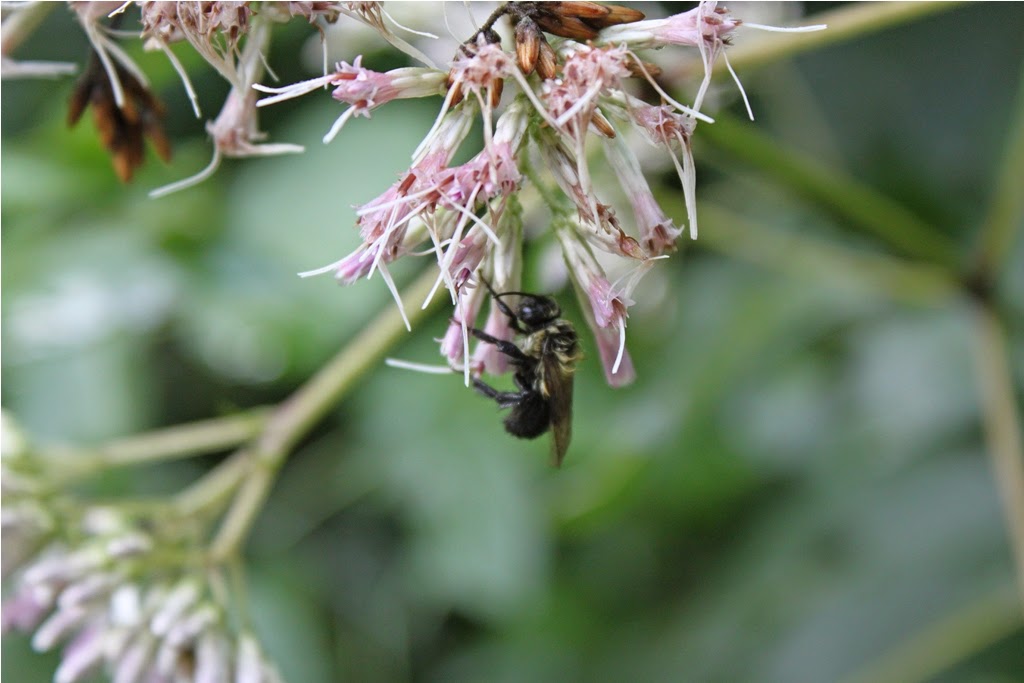
| Honey bee on a joe pye weed flower |
Since I first heard about honey bees’ colony collapse disorder, I’ve paid attention to bees. Before that, I pretty much ignored them and avoided them when possible. Since 2006 when the disorder first became public knowledge, I keep a lookout for them and try to gauge if I am seeing more or fewer of them.
The winter of 2012-13 saw bee colony losses above 31%, slightly higher than the previous six year average of 30%. For the purposes of their studies, the US Dept. of Ag. considers "winter" losses to run from October through the end of April. One difference noted by the researchers was that more colonies appeared to be dwindling away, rather than outright and sudden collapses. Winter 2013-14 produced better results, with colony losses at just over 23%. Despite the improvement, the losses this past winter are still above the 18% that beekeepers consider economically sustainable, and researchers still don’t know why 2013-14 was better. It may be nothing more than a yearly fluctuation.
While colony collapse disorder is complicated and seems to have multiple causes, one of the largest contributors is the varroa mite, an Asian bee parasite that first appeared in the U.S. in 1987.
This summer I’m seeing fairly average numbers of honey bees. I see them on the woodland blooms around the cabin, such as this joe pye weed in today’s photo. The next door orchard is less than a mile as away as the bees fly, so certainly some of the ones that are around Roundtop are from there, though I also occasionally find a hive tree. It’s a good day when I can start one by seeing a few honey bees. It makes me feel as though there’s still some hope for the world.
Friday, August 01, 2014
Summer zooming by
![]() |
| Northern red salamander |
Where is this summer going? It’s zooming by. I only have a few weeks left of adventure camp. The days are growing shorter, and I needed my headlamp this morning. The millipedes are out, and they are a late summer resident on Roundtop Mountain.
The kids at adventure camp caught a huge crayfish this week, one whose pincers were a good two inches long. The salamander is, I believe, a northern red salamander. For a while I thought it might be a juvenile long-tailed salamander, which Beaver Creek has in abundance. But after studying photos of both, today I’m going with the red salamander.
Kids at camp catch a variety of things. Crayfish are the most common. Nearly everyone catches one or more of those. Salamanders are caught less frequently, though nearly every group of kids catch at least one. Other kids happily ignore crayfish, salamanders and minnows and prefer to catch water striders (or water skppers or water spiders). I don’t know why. They certainly aren’t that exciting to me, but there’s a reasonable minority of kids who think netting water striders is the coolest thing they can do. Whatever. As long as they are enjoying themselves.Now that summer is past its early days, the millipedes are starting to appear. One thing I’ve learned in the years I’ve been doing adventure camp is that kids are fascinated by millipedes. They will happily line up with flattened hands and let millipedes walk across their hands, sometimes racing to the end of the line after the millipede reaches the next set of hands to line up again. It’s a kid thing. I mean millipedes are kind of cool but I never put them in the way cool category of things. Kids, however, are thrilled with them.
Tuesday, July 29, 2014
Losing daylight
![]() |
| Curious eastern cottontail rabbit |
![]() |
| Fleeing |
The need for a headlamp is noticeable as I start my morning walks. We begin our walk in the forest, with its thick canopy of summer leaves. It is dark in a summer forest, darker than during winter’s longer nights, when the trees are bare and my view of the sky is unobstructed. Once we leave the sheltering dark of the woods, the pre-dawn sky is pale enough for easy walking.
I am always surprised by how this change in the day’s light sneaks up on me. I know it is coming but I never expect it "today." This morning was my reminder, my wake-up call, that a headlamp is soon needed. Tomorrow, if the sky is undimmed by morning clouds, I will have a brief respite before the headlamp is truly needed again. But by next week, even with a clear sky, the headlamp will again become a morning fixture on our walks.
Monday, July 28, 2014
This past Saturday I once again had the pleasure of attending the Kittatinny Roundtable at Hawk Mountain Sanctuary. The annual event is hosted by Laurie Goodrich, the senior monitoring biologist there, who is also the vice-chair of the Hawk Migration Association of North America (HMANA).
At HMANA’s chair, I was called on to say a few words about what HMANA is up to and what we are planning. About 20 people, mostly hawk counters and site leaders from hawkwatches in Pennsylvania and New Jersey, attended. Rich Conroy, a HMANA board member from Philadelphia’s Militia Hill Hawkwatch, also attended.
We got to hear about geographical changes to the American Kestrel’s range. The species is generally declining due to habitat loss but in a few areas is increasing. Nick Bolgiano has been studying this and gave a brief overview of what his research has found so far. Loss of farmland and farming practices seems to drive this decline.
Laurie reported on her Broad-winged Hawk monitoring program, which involves first catching and then radio-tagging several adult and juvenile birds. She wants to see where the Pennsylvania Broadwings winter and where and how they migrate.
A highlight of the event for me is studying the hawk results from the previous season. We discovered that nearly every site reporting tallied record low or near-record low counts of Northern Harrier in fall 2013, and we wondered if this is the next raptor species of concern. In fact, most other accipiter genus species were also counted in lower than average numbers. One year’s data is not enough to draw any conclusions, but it is enough to pay attention to and see what happens in the upcoming migration year.
The Kittatinny Roundtable is always a lot of fun, too. It’s not often that hawk counters gather—they are usually too busy counting hawks!
Wednesday, July 23, 2014
Summer view
Ah, humidity! Soupy air obscures all the views today. The mountains just a few miles away look blue instead of green. The distant mountains, some 10 miles across the valley, are invisible. It’s summer.
The vegetation has that mid-summer green look to it, a deep and rich shade with not yet even a hint of the dullness that will set in during August. That month is usually the year’s driest in this area, and for many years I attributed that dull brown-edged green to the usual lack of rain. But since then I have lived through a few Augusts where rain was surprisingly plentiful, and the dullness still appeared. So now I call that dullness a sign of pre-autumn.
But today the trees are breathing nicely, exhaling oxygen and offsetting all that carbon dioxide that we humans are exhaling. Water vapor is returning to the sky, and a storm will probably result later. It’s summer in Pennsylvania, and this is just another normal day.
Monday, July 21, 2014
Summer ruminations on winter's impact
I might not have seen many fawns this summer, but I sure am seeing a lot of turkey poults. I found another brood of them, this group not far from my cabin. The brood was 6-7; the babies still quite small. They, mom and an "auntie" were taking a dirt bath at the very edge of the road. I stopped the car and they soon scurried back into the woods.
Turkey broods appear variably, with the severity of the winter a determining factor. One PA study showed that egg incubation after one cold and snowy winter (1999) didn’t begin until around May 15. During more typical winters, incubation begins around April 28. The hens incubate the eggs for 28 days. As I am only just now starting to see the poults, I would not be surprised if the hens didn’t begin incubation until roughly the end of May. The younger hens typically don’t start to incubate until a week or so after the mature hens.
None of the poults I’ve seen over the past week flew, though young turkeys can fly a bit within about 10 days. I suppose that just because I didn’t see any of them flying that doesn’t mean for sure that they couldn’t fly, but I can say the birds were quite small and it wouldn’t surprise me if they were under 10 days old.
So in doing the math, I’m going to say that the small brood I saw on Saturday was just 10 days old, which would make them hatched on July 9. That would mean incubation for this brood began around June 10-11. That is very late, and also suggests both hens I saw were younger birds, who would have started incubation later anyway.
Certainly 2013-14 was a colder winter than 1999, when the turkey nesting study was done. So it is likely that nesting for turkeys was even later this year than then. The little ones should still have ample time grow and ready themselves for this upcoming winter. Poults gain weight quickly and by the time they are seven months old will weigh 8-12.5 lbs depending on gender. Still, with nesting coming so late this spring, another tough winter in the upcoming season wouldn’t do the species any good locally. Winter is tough enough on the younger ones, let alone poults that may be as much as a month younger when winter arrives than is typical.
Tuesday, July 15, 2014
Quite a large family
Rain and more rain. Everyone and everything acts tired of it. The large turkey family of 10 poults appeared barely a minute after the latest round of heavy rain ended. I grabbed this shot with my phone as I was driving home last evening from a meeting. I was afraid that if I took the moments to reach into my purse, grab my real camera and take the shot the turkeys would be gone. My phone was closer, so I used that.
Not a mile down the road several more turkey, with no poults, were together in the same field as a small herd of deer. The animals all appeared for an evening promenade or meal just as quickly as that rain ended.
So, needless to say, everything is soaked around the cabin. Wellies are my footwear of necessity. The forest is as lush as a jungle. It IS a jungle in all but official name. "The Appalachian Jungle" just doesn’t have the same ring as the Appalachian Mountains.
Friday, July 11, 2014
Made it!
Whew! I hope I don’t have any more storms like that for a while. 85 mph straight line winds cause as much damage as an F1 tornado. Trees are down all over the place, as are garages and sheds and a few barns, too.
I escaped damage at the cabin, but have been cleaning up at my family’s farm, where dozens of trees are down. For some of the biggest ones that are still hanging over the barn we will need to get professional tree trimmers to remove them, though those people are now booked solid for a few weeks. Fortunately, no more severe weather is on the horizon for a while.
In better news, I have finally seen a fawn! This was no wobbly spring fawn, but a good-sized fawn of summer, well able to follow its mother across the mountain road in front of me.
Tuesday, July 08, 2014
July sunrise
Summer sunrise bodes summer storm.
I close the windows, turn on the air conditioner and do the little tasks, like filling up water dishes, just in case of power loss. All it takes is one tree, on the power line's long span up the mountain, to fall over in heavy rain or get struck by lightning. Just one, and I'm out of power.
Up here, we are always the last to get our power back. Towns and roads with more people are the first priority. So batteries are stored, electronic devices are kept charged and lanterns are always handy. I just never know when I will need them, so they are always at hand. If I don't need them this time, today, then it will be next week or the week after. Such things are routine here. Preparedness is a way of life.
Monday, July 07, 2014
Summer light
The past weekend was a perfect summer weekend in this part of the country. It was warm and breezy but not hot, not humid and not hazy. The temperature hovered around or just under 80 degrees, with pleasantly cool evenings. I didn’t run the air conditioner at all. Three whole days in midsummer with pleasant weather is a rare joy, too rare unfortunately.
I spent as much time outside this weekend as was humanly possible, finding any excuse to walk a little further or take the dogs for another traipse through the forest. We saw deer and turkeys, squirrels and opossums, a ring-necked snake, largemouth and smallmouth bass, heard gray treefrogs and yellow-billed cuckoos. I pulled black raspberries from the bushes and ate them straight away, my fingers turning purple with their juicy goodness.
I saw almost everything there is to see here in summer. Everything there is to see except for fawns. Truly, I must be the only person around not have seen a fawn yet this season. My neighbor up the mountain claims to have seen four at once. It’s a mystery why I haven’t seen one, but there it is. Such is life.
The light in those early morning walks has a clarity that is unique to summer. Autumn’s light is golden, winter’s light is soft, spring’s bright and warm. Summer’s light gleams with a bold clarity that is surprisingly delicate in the early hours of the day.
The hot, hazy and humid weather has returned today, though won’t last but a day or so. And since today is a work day and my time outside is limited, anyway, the nuisance of the 3H’s also has limited impact. I’m still hoping to see a fawn, somewhere, before their spots disappear.
Wednesday, July 02, 2014
The Three H's have arrived
I am ready for another winter.
![]() |
| Ironweed, aka wild butterfly weed |
The dreaded three H’s—hazy, hot and humid—have taken over Roundtop today. Those three words are like curses to me. I can imagine a whole range of curse sayings about them: "may you live where it’s hazy, hot and humid" being one that comes to mind today.
Overnight, the mountain didn’t cool down even a little bit. That alone is unusual. More typical is that sometime after midnight, even the hottest days start to give up in the face of darkness. Not so last night. It was one of those fortunately rare days when I never turned off the air conditioner and was glad to have one to make the inside bearable. The dogs didn’t get an evening walk until it was dark, and even then we all returned to the cabin hot and sticky and ready for water.
This time around the worst of the heat will break sometime on Thursday, so it’s only 36 hours or so that I will have to suffer. The frightening part is that it is only early July, so there’s a full two months ahead where I have to face at least the threat of the three H’s. That’s another reason I dislike summer. Too many days of the three H’s and too many days when those three H’s might reappear at any moment.
I am ready for another winter.
Subscribe to:
Posts (Atom)