Showing posts with label Ruminations. Show all posts

Saturday, March 19, 2016

Breaking new ground

Dog-toothed violet or trout lily,--take your pick
I have had the worst cold of my life for going on two weeks.  My sister gave it to me, and I told her during the worst of the cold that if I’d gotten this cold ten years from now it would either kill me or put me in the hospital.  I have now returned to the land of the living, though the cough and some remnants still remain.  No long walks in the forest for me just yet, but I am well enough to wander around my own little acreage.  And that is where I discovered the first leaves in my dog-toothed violet/trout lily patch.
The pretty bi-colored leaves aren’t hard to see, but they can be hidden by fall’s leaves as they are only up by an inch or two at the moment.  It’s a good thing the flowers aren’t out yet.  Tomorrow I will get what is virtually certain to be the last gasp of winter on what will be the first day of spring.  Several inches of wet, heavy snow are predicted, a true “onion” snow, as such things are called in this area.
Other signs of spring are popping up.  Spring is not yet exploding but it’s moving forward, about like when the first kernels of the popcorn start to pop.  The first phoebes arrived a week ago.  I have had an American Coot on the smallest snowmaking pond for a week now.  It shows no signs of leaving.  The ski resort has closed for the season, too.
As I type a local Blue Jay is performing its Red-tailed Hawk call.  It started doing that about 10 days ago and is so pleased with itself that it now calls all over the mountain.  It particularly performs the call just before landing in my bird feeders, perhaps hoping to clear the decks so it can have the feeders to itself.

I am glad this cold has nearly run its course in time for me to enjoy the start of spring, even if I have to shovel to get to the chicken coop one more time. 

Friday, March 04, 2016

Could this little snow...


…be the last?  
It’s early, even here in southern Pennsylvania, for the last snow to be on the fourth of March.  However, the next week looks spring-like, and by the time that weather pattern is gone it will be mid-March.  And after mid-March snow becomes fairly unlikely here.  Cold weather can abound in March, but precipitation—not so much.

So I am enjoying this little bit of snow this morning.  It likely won’t last much past lunch time, when the temperature rises above freezing. Despite the 31” blizzard of late January, 2016 brought fewer snow events than is typical. I only recorded 6 days with snow this winter, and half of those were about the depth of this little snow.  Last year was exceptionally snowy with 15 snow events against an average of 8. The snowfall in winter 2015-16 stands (so far) as one below average, though that big blizzard sure tried hard to make up for the lack. 

Monday, February 29, 2016

Leaping around


Winter’s snow is nearly gone.  Patches and piles remain, as does ice on the lakes and ponds. 
After a warm day yesterday I really thought the ice on the lakes would be gone. So early this morning I went down to Pinchot Lake and discovered ice still covering it.  The small lagoon has open water and is currently populated by 21 Canada geese, but the waterfowl I’m most interested in seeing don’t like the little lagoon and can only be found on the large lake.  I would not want to try and walk on that ice at this point.
Of the “spring” birds I have so far only seen and heard red-winged blackbirds.  The robins were here all winter, and it became common to see robins foraging beside juncos, which I always find amusing.  Those species can’t be well acquainted with each other in this area as their timing doesn’t usually overlap, as it has this year.
February started out cold, but ended up warm and so ended up being a fairly average month in the temperature department.  I wonder how a leap year affects daily temperature averages.  As today would normally be March 1, do weather people compare a leap day to March 1 or keep it separate from the other days?  Do daily temperatures skew differently in a leap year because of the extra day?  It’s a thought I am pondering this morning on this once in every four year event.

Wednesday, February 03, 2016

Before the rain

I took this snow photo on Tuesday morning, before the clouds rolled in.  At the moment it is raining (!) and raining hard, with fog to boot.  It’s the kind of day for me to stay inside and work around the cabin. I’d say the weather isn’t fit for woman or beast, but the bests don’t mind the heavy, cold, near-freezing raindrops soaking their coats as much as I do.

My plan for the day is to do some housework, peppered with a little cooking and a couple of cups of hot chocolate or flavored coffee.  It’s a ham and bean soup kind of day, too, though any good, hearty, hot soup would do as well. It's a good excuse to spend a few hours watching the feeder birds, too, even if it's only the "usual suspects" that are frequenting them this year.

Tuesday, December 15, 2015

No ice, no snow, open water

Sunrise over Pincho Lake - December 13, 2015
Non-winter is in place here on Roundtop Mtn.  The ski resort hasn’t yet been able to make snow, as the nighttime temperatures are well above freezing.  I haven’t turned on the electric heat in the cabin, though on a few damp mornings, I had a fire in the fireplace.  For the past week I haven’t even needed that.
Birds are not flocking to my feeders.  They are apparently still able to find natural food in the forest.  Oh, a few of them show up in the morning and again in the evening. I think it’s more to check that food is available than from any real sense of needing it.  By this time turkey and black vultures have usually departed at least some ways to the south.  Yesterday, I saw 9 of them twirling around the top of Roundtop. 
El Nino, the apparent cause of this warm weather, is showing its impact.  How long this record-breaking, strange weather will last is unknown.
Today, a northwest wind is driving down the temperature, though it’s still above 50°.  The northern robins, a Labrador subspecies I believe, still forage through the forest.  When I was younger, they were called woods robins locally, browner and larger than the summer robins that breed here in that season.  I saw a flock of 14 yesterday.  I usually find them by sound.  They tend to hang together in a loose flock, skimming through the forest.  I see them mostly in the mornings and evenings.  Most winters I see them into January, though they do disappear during the worst of a winter.  In February they often reappear on the first sunny day. They are always able to find open water—perhaps from a spring-fed pond, a puddle or an open stream.  So far this year, the pickings are easy and open water is everwhere.

Wednesday, December 02, 2015

Hunkered down

 It’s hard to take photos in a heavy rain, which is why you haven’t seen many blog posts from me, now that I am mostly recovered from a hard cold.  The rain is accompanied by low clouds and fog, so the lighting is terrible.  Sunrise is now at 7:11 a.m., and with the rain and overcast skies, the chickens do not arise for a good 30 minutes after the sun’s alleged rise.
If I’m lucky, I can find enough light around noon to snap a quick shot, but they are nothing to write home about.  The wet darkens the tree trunks, which would be a nice effect if the lighting was cooperative, which it isn’t.
Pennsylvania’s rifle deer season started on Saturday, so traipsing around in the woods, even if the weather was cooperative, is not the thing to do right now.  I heard a lot of gunfire the first 30 minutes of the season, far less later in the day, and not more than 1-2 shots since then.  The deer are hunkered down, as much from the rain as the hunters.  Most of the hunters I’ve seen are waiting for the weather to improve before resuming their hunts.  My own family hunters reported not seeing a thing even though we routinely see three buck promenade across the grassy boulevard that leads down to our pond our at the farm.
Here on Roundtop, I saw the old doe this morning.  She lives in a narrow band of forest between my cabin and my neighbor’s cabin.  She is used to hearing the squealing of my neighbor’s elementary-aged girls and the barking of my dogs.  When flushed by one or the other of us, she just crosses the lane and finds another spot a few feet away.  I hope she makes it through doe season in another week or two.  I like having her around, though she is an old doe who didn’t produce a fawn this season.  I like watching her.  She is about half-tame, whether from habituation to us or because her age makes her less inclined to bolt like a youngster.  She would be tough-eating for a hunter.  I am torn between wanting her around and thinking that perhaps a quick shot would be kinder than a long and painful decline from age in a harsh winter.

Friday, November 27, 2015

Old rock, "new" rock


My apologies for the lack of posts.  I’ve been harboring a cold and have done little except wrap myself in a blanket and drink gallons of hot tea.  I am over the worst of it now and so am beginning to venture out again, if not venturing very far just yet. 
 An advantage of not being able to venture too far is that I am looking more closely again at the forest around my cabin.  Today, the boulders that line the lane and my own front forest caught my attention.  In summer the rocks are nearly hidden by annual growth, and it’s only in the leafless seasons that I can see them well.
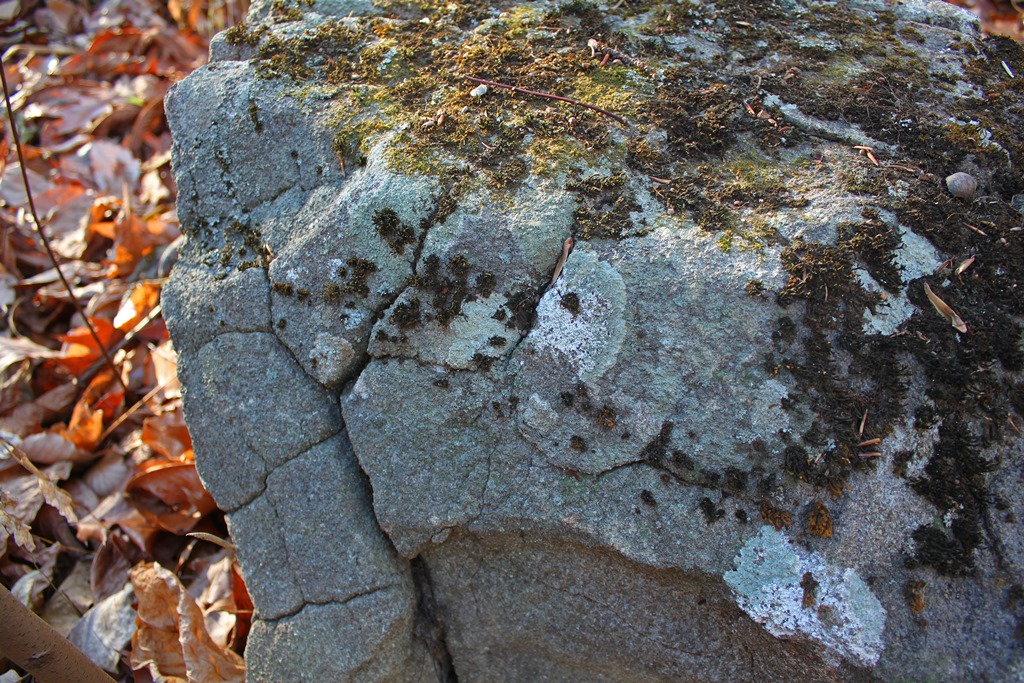
The weathered and cracked boulders are the most typical of the rocks here.  These are desk-sized rocks that have been exposed to the elements for who knows how many years.  Exposure to ice and rain are doing their best to break them into the smaller rocks that are even more numerous all around on the forest floor.  These little rocks were former boulders, still working their way down in size into ever smaller rocks. The boulders are home to moss and lichens, too.  Sometimes a small fern, usually a Christmas fern, manages to find enough of a foothold to grow in one of the cracks.
And then I have what I call the “new” rocks.  They are not new in the sense of overall age. Likely, they are as old as any of the other rocks around the mountain.  But they are newly exposed to the elements and so are not yet cracked and worn or split into small pieces. 
These rocks were exposed less than 50 years ago, when the lane up the mountain was first built.  My lane is not the first road up the mountain, and it may have even been created from an older, narrower road that ended at a sadly gone log cabin. (I was fortunate enough to see that abandoned cabin in the first years I lived here, before it was damaged by a large tree and then vandalized by late night partyers.) Today, these newly exposed rocks line the lane.  They are smooth and bright, usually square-ish.  Weather has not yet taken its toll on them and won’t for who knows how many more years.  But now that they are exposed to sunlight and rain, that slow destruction will begin.  None of us will see that, of course, and perhaps humans won’t even be around the earth anymore when that happens.  But it will happen.  Time is patient.

Wednesday, November 18, 2015

Embracing the dreariness

I am enjoying a dreary November day.  It is a bit foggy and overcast, so the day is dark.  The air is still and the trees are bare.  It’s chilly.  I had a fire in the fireplace this morning and may need one again before long.  For now, I am wrapped comfortably in a wool sweater, my hands warmed by a cup of hot chocolate.  This is how November should be.  At least it’s what I think of when I think of November. 

Novembers should be chilly and raw, not sunny and bright like an October afternoon.  So in an odd way, the dreariness makes me happy. Today feels like a normal November day, dreariness and all.

Thursday, November 12, 2015

Dark and dreary


It was so dark and dreary this morning that I was late getting up.  I kept waiting for some semblance of daylight to appear, and it never did.  A black cloud hung heavily over the mountain, so even at 7 a.m. I needed a headlamp for a little while, and Doodle the rooster didn’t crow until almost 7:30 a.m.
The rain, while not heavy, was cold and the breeze blew little slivers of it onto my face, stinging it.  Even the Shelties were happy to turn around and head back to the cabin this morning and that has to be a first!  Birds were hunkered down in whatever shelter they could find, but a great horned owl was still calling just before 8 a.m. 
By afternoon, the day improved, and the sky soon filled with turkey vultures and a pair of red-tailed hawks.  The little birds came out of hiding too.  It is, after all, November and this is how November is supposed to be.  Or even colder, though it’s still sort of early enough in the month to let that pass for now.  Here on my mountain, November is a transition month.  It can be a leaf-less repeat of October, or it can be winter.  So far, this November is milder than average, but with the coldest part of the month still ahead, it’s too soon to complain about just how mild it’s going to be.

Instead, on this chilly and blustery morning, the dogs got a bit of a walk.  When we returned to the cabin, we had a fire in the fireplace, and I had a cup of hot chocolate, and that was enough to scare away the chill. 

Monday, November 09, 2015

Early morning frost


Roundtop has had both frosts and freezes this fall, but this morning was the first hard frost where I could get a photo.  Even though the temperature was a chilly 27 for a few minutes this morning, as soon as the sun rose above the horizon, the warmup began.  Now, just 3 hours after the early morning frost, the temperature is already up to 50, and the frost is long gone. The photos are all that is left.
I like the shadow of the rising sun’s rays on the oak leaf.  You just know that frost will be gone momentarily.  The photo captures the coming warmth of the day in the sun shadows while still showing the result of a cool night. Most of the leaves are down now.  The few that are left are no longer even bronze but are more like a deep copper.  The color is not much different than the color of the bark of the trees, so the forest is nearly monochromatic today.  Even so, I find this a pretty time of year. The long vistas are back.  I can see the mountain to the west, the pond to the north.  I can even monitor the chickens’ whereabouts instead of just hearing their scratching.

I can see the sky again, and monitor the coming rain without having to leave the cabin to find a patch of open sky.  Already the air has a chill, nearly raw feel to it.  I was forced to clear as many leaves off the decks that I can, to avoid a sodden mess when the rain comes.  Likely, my work will only be partly successful, as more leaves are already coming down.  I hope the most of them are removed, but one good wind gust before the rain will be enough to negate my work. 

Thursday, October 29, 2015

Falling leaves

It’s official.  The peak of fall colors is past and the leaf drop has begun.  Of course, a hard rain last night and strong breeze today will push things along faster than is typical but that’s how it goes.  This is the week when I wade ankle deep through the forest’s leaves that litter my porch and deck.  I sweep the leaves every evening but for at least a week it does no good. Every day there are more.

One year I refused to sweep the leaves for a week, and I was soon knee deep in them on my front porch.  Having tried that once, now I sweep them daily until the leaf drop is over.  What I like to do is to study the leaves a bit and to name the species of trees they come from.  In my forest, white oak, red oak, tulip poplar, hickory and American beech are the most common species. I also find a few others, like chestnut oak, sassafras and wild cherry.  Sometimes I find an American chestnut, but these are likely from a younger tree that has not yet succumbed to the disease that devastated this species.


The leaves are blown from all over, who knows where, really, so if I find an unusual leaf, trying to then locate the tree it came from is pretty much impossible.  That doesn’t stop me from looking. Sooner or later I will be successful with one of them.


Tuesday, October 20, 2015

Dreams of daylight


This morning as I was walking the dogs, I was feeling a bit disconnected from the forest around me, and wondering why since I was, at that moment, walking in the woods.  For a moment or two I blamed the Shelties who were particularly full of themselves and not inclined to listen this morning.  But then I realized that it wasn’t them.  It was the dark.

I have reached that point of the year where I am only home and in the woods when it is dark. As a result I miss so many of the things I notice and love about the forest.  Stumbling in the dark with a fading headlamp isn’t conducive to noticing what I usually see and hear.

Currently, I hear no forest birds, though occasionally a distant great horned owl calls from way up the mountain.  During daylight the forest birds keep up a running conversation of what’s going on around us—the alarm calls when a hawk soars overhead, the cawing of the crow family with all their variety of vocalizations, a stamp from one of the increasingly tame deer.

I also can’t see much, even with the headlamp isn’t fading.  As just once example: Have you ever noticed while walking through a wood how the dirt or mud changes as you near areas where people live? Have you noticed how the soil changes in different areas of a mountain? How the soil is different from the north side to the south side?  From the top to the bottom?

None of that is possible to notice for me now in the dark.  And this morning the stars were hidden by clouds, and about all I could tell about the kind of clouds that were up there was that they were blocking the stars. I miss the daylight conversations of the birds, the subtle differences in the soils, seeing the different shapes of the rocks that face the north or the south side of the mountain, the changing vegetation.  Night has its charms, but perhaps not as many as daylight and certainly not to the exclusion of daylight, as my schedule dictates today. So I sighed a bit, cautioned the Shelties yet again, and walked on.

Thursday, October 08, 2015

Changing


Sunrise at Roundtop.  October 8 2015
It won’t be long, another 7-10 days, and the leaf color at Roundtop will be at or near its peak.  Looking at the trees today, that’s a little hard to believe.  The leaves are changing slowly, with still more green than color.  The morning light is fully that of October’s golden rays, though.

I wouldn’t say the leaf change is late.  Timing seems pretty normal at the moment.  I think it’s more than I’m still in the summer mindset of being used to having greenery around me, and the autumn changes isn’t yet far enough along to jog me into a fall mode. And yet I know the prime color season and the first frost can’t be far away.

Perhaps it’s because I haven’t yet seen a junco or a white-throated sparrow to officially mark a new turning in the year’s spinning.  A friend, further east of here, has already had the little sparrow at his feeders, so I know it won’t be long before the new tribe of sparrows arrives.  Now that summer’s ubiquitous chipping sparrows have left, the mountain is rather free of little birds.  For the moment, the mountain is dominated with medium-sized birds, like bluebirds and blue jays and the larger Canadian robins that arrive after the local ones have headed further south. With the leaf canopy thing, various woodpeckers seem more prevalent, but likely it’s just that I can see them better again.

So I’m waiting to be kicked into fall. I just don’t quite feel it yet. Maybe next week.

Wednesday, September 30, 2015

Fog is here to stay for a while


Heavy rain and fog makes the ever-shortening days feel even shorter.  This morning the chickens weren’t even out of the coop when I went to feed them and let them out.  They made a few noises when I talked to them, but that still didn’t encourage them to come out.

I have not yet been plagued by marauding fall raccoons, but a local opossum has discovered the chicken feeder and waddles around occasionally.  I tend to see opossums and raccoons most in spring and late fall.  Sightings are rarer in midsummer around my cabin.

Opossums don’t hibernate and winter is, understandably, difficult for them to survive. That’s why I see them more often then and often in daylight, too.  They come out when the day warms up to look for food. Around my cabin the chickens scatter their feed all over the place or sometimes leave untouched the produce scraps I give them.  Both raccoons and opossums will take advantage of that.  It’s far too early in the season for either species to find food gathering difficult.  Likely the opossum I had was just wandering through the area, perhaps hoping to keep the location of my cabin in its memory banks until winter makes for slim foraging.

I am starting to see some color change in the trees around the cabin. The overall effect is still all green, but individual trees and branches show color.  Once this rain and Hurricane Joaquin clear the area and clear out the fog, I’ll try and get a few photos. For now, it looks as though rain and fog will be covering the forest at least though Monday.  In other words, the fog photos aren't going to go away too soon!

Friday, September 11, 2015

September morning


September finally looks like September this morning—no more August humidity or July heat.  I just hope September stays for the rest of the month now and those other two months will disappear until next year.

With summer’s hottest months hanging on for so long, I have nothing to report yet about conditions pointing towards fall. I can say that after 3” of rain, which was much needed if not all at once nor in the monsoon-like torrent that fell, the mountain is crisp and clear again. Overnight the temperature dropped into the 50’s for the first time since June.

Hawkwatching season has begun and that’s what I will be doing for much of next week.  Today, on this beautiful, clear day between two rainy days, hawkwatchers who are already sitting on a mountaintop somewhere should be treated to a good migration day, likely a decent Bald Eagle day, too.  I’m not complaining at all about their good fortune, as I expect to have some excellent days myself during the next week when Broad-winged Hawk migration will peak in my area.

I’ve already heard from the Cape May area this morning that overnight a goodly stream of songbirds is already moving, particularly thrushes of several species. The birds know summer is over. I just hope the weather gets that message now.

Tuesday, September 01, 2015

September 1 blues

September sunrise with setting moon

Summer is giving me at least one more blast of hazy, hot and humid weather over the next three days.  But in other ways the oncoming season of autumn is ever more evident.  The barn swallows have left the mountain, no longer plying the mosquitos above this little pond.  They left on or about August 27 or 28, as regular as ever. The swallows are the first to go, though I haven’t heard the yellow-billed cuckoo for a while.

I now frequently see red-leafed poison ivy, tall stands of purple thistle and less undergrowth as the annual plants begin to die back.  Mullein is brown and looks burned.  The constellation Orion is high in the morning sky before dawn once again. Even my chickens are producing fewer eggs than in the early days of spring.

Now, if only the temperature would follow suit.  It will, I know, and likely by Friday, but I’m impatient.  After all, it is September.

Friday, August 28, 2015

Going by so quickly


Some days I wish these lazy, hazy days of summer weren’t so crazy.  Too many paths go unwalked, too many stars aren’t stared at and too many birds aren’t looked for.

The season moves, and I’ve already missed so much of it. Even though summer isn’t my favorite of the seasons, some things can only be enjoyed and seen in summer, and so much of it is already gone.  The local soft ice cream stand closes on Labor Day, and I’ve only partaken once.  I managed to get my swimsuit out of winter storage but never got to go swimming.  I have yet to have a cookout or make s’mores. The seat cushions on my outside chairs need replacing, and the stores have already put them away until next summer.

Friday, August 14, 2015

a midsummer's eve

The midsummer forest has its own special look—the bright greens of spring have faded but the dry and brownish shades have yet to appear.  At the moment, the woods are a deep shade of emerald, made brighter by the golden rays of late afternoon.  A few of the annual plants are gone, and the forest floor is a bit more open than it was in May and early June.  When the temperature is comfortable, as it has been this week, the time is a lovely one to walk in the woods.

Each season and mini-season has charms, of course.  Midsummer is not always my favorite, though much of that is because of heat and humidity. When those are not oppressive, the season is delightful and a fun time to explore in the forest.

Last evening was one of those times, and my wandering was accompanied by the sound of wood thrush, still singing, deeper in the forest.  The mosses are already sprouting seed pods, tiny little groups of stalks like miniature fields of wheat, all within a span the size of an open hand.
Back at the cabin I found a lovely and large moth, likely a sphinx moth, that refused to light and let me look at it closely.  It fluttered deeper into the woods and finally away from me, forever to remain a mystery, like so much of the forest, especially on a midsummer eve’s ramble.

Monday, July 13, 2015

White

Queen Anne's lace
Midsummer is especially lush on Roundtop this year, due the near unending rain.  This past weekend was the first in a month where it didn’t rain and that respite, while it will be short-lived, was much appreciated.  The clear weather allowed me to get some outside work done, but I’m afraid I will never catch up at this rate.

Wildflowers are certainly enjoying the wet summer. They are profuse nearly everywhere I look. I hope the local bees are populous enough to properly pollinate them. I do see some bees, if not nearly the numbers I should be seeing.  Colony collapse disorder apparently took an especially harsh toll last winter and this spring, with losses running about 42% of all colonies.  This comes after a year or so when the losses didn’t appear to be getting any worse, and beekeepers were very cautiously optimistic they could learn to deal with it. So much for that hope, I’m afraid.  This year I can probably count the number of bees I’ve seen on two hands.  That’s more than a little scary.

Butterflies, which also perform pollination duties, seem to be around in normal numbers, so that might help.  Butterflies are far less efficient than bees at pollinating, but at least it’s something. The difference is that butterflies have longer legs than bees, which holds them away from pollen. Bees are built for pollinating and can capture pollen pretty much with their entire bodies.  And of course, bees are busy little things, while butterflies flit prettily and slowly from flower to flower.  One thing butterflies can do that bees can’t is see the color red, so they are very effective pollinators of red flowers.  Butterflies prefer larger flowers with flat or broad surfaces so they can more easily land. A few moths, such as the hummingbird moth, also pollinate but how many of those do you see around?

I’ve been talking about wildflowers and how they are affected by a lack of bees, but that’s really only a side issue.  More than 80 different farm crops in the U.S. depend on pollination.  This covers all of the berry crops as well as apples, cherries, plums, avocados and all the almonds.  The list goes on to cover dozens of food crops. I look for bees every day when I’m out in the woods, but so far there’s little joy in reporting the number that I see.

Monday, June 01, 2015

need wildflower ID help


While a rainy Sunday interferes with my time to get out into the forest, I will not complain about yesterday’s weather.  The forest has been too dry for too long, as the spring rains here were meager this year.  An inch of rain will not reduce the current deficit, but it certainly helped.

This morning raindrops cling to everything, and fog obscures the mountain tops.  Birdsongs carry over a longer distance in the thick air. I hear the wood thrush, the ovenbird, an Eastern pewee and the ever-present phoebe.  I keep waiting to see the family of blue jays that are nesting in a crook of the beech tree by the side of my driveway, but they are still in hiding.

I saw a large snapping turtle a few days ago but didn’t have my camera with me, and despite a quick retreat to the cabin to get it, the turtle was gone when I returned.  Such is life.  Walking with a dog and a camera, or at least my dogs, is a recipe for disaster.  And it’s probably just as well that Skye didn’t get to meet the snapping turtle, too.

Can someone help me with the flower ID in today's photo?  Is it a monkeyflower?