Although Memorial Day is only the unofficial start of summer, the local goslings are the size of chickens already. One of the three local families was on parade yesterday afternoon, and I couldn’t resist snapping a shot of them. All told 27 geese and goslings spend most of their days on this little pond. The total breaks down to 6 parents, 2 “helpers” that are probably last year’s babies and 19 goslings.
This group are the biggest and are likely a week or so older than the other two groups, which appear to me to be identical in size. Even this group doesn’t have any feathers yet, though.
This holiday weekend here was a hot one, and I hope it doesn’t mean the rest of the summer will be as hot. Worse than the heat was the oppressive humidity. Sunday was the worst day for that. Monday was likely even a degree or so warmer than Sunday but felt better as the humidity was slightly lower. Today, severe storms are predicted to clear out this unseasonably warm weather and return the mountain to normal temperatures again. I’m ready for the normal temperatures, but I’m not a fan of severe weather in any form.
After living in the woods as long as I have, you might guess I’d be used to severe weather, but I’m not. Wind is my most common bane. Surrounded by trees as I am, wind is an almost ever-present danger that can wreak havoc in any season. Lightning ranks #2 on my list of scary weather. I’ve had some lightning strike so close to the cabin that the flash momentarily blinded me. And the strike was still a good 100 feet away. Secondarily, even not-terribly-close strikes knock out electricity and can cause other damage. My neighbor’s well pump was once knocked out by a nearby strike—though mine was fine that time around. So extreme weather of one kind or another is always a concern. I don’t let the threat or even the reality of bad weather keep me from living in the woods, but I’m always glad when it’s over, too.
Tuesday, May 29, 2012
Thursday, May 24, 2012
Misummer in May
Is it just me (or just here) but don’t the leaves on the trees already have that deep green shade of midsummer to them? Early spring leaves are a bright, almost a neon green. Midsummer leaves are a deep emerald, and by September, the leaves are taking on a duller, brownish green. By late September, the leaves look more than a little rough around the edges.
So here it is late May, and the leaves already have that July shade of green to them. So what’s that going to mean? That August brings the brownish green? And if so, what does that mean for September? I probably won’t know the answer to that one until September, but it does make me wonder.
This morning the mountain was so foggy that even at 7:30 a.m. my camera wanted to use the flash on everything. The fog improved later in the morning, but the day is still a “soupy” one. The upcoming weekend promises to bring the first almost-heat wave of the season. In this area a heat wave is officially three days in a row where the temperature is 90 degrees or above. We won’t get that, fortunately. But the temperature will be at 90 for at least one day and near 90 for at least two more days. Close enough, and more than hot enough for May. I’m just not ready for that. Of course, being a winter person, I’m pretty much never ready for the heat of summer, especially when it looks as though it will last for four months.
Wednesday, May 23, 2012
Baby Dog doesn't do snakes
Last evening I found a nice, good-sized black snake along the edge of the lane near the cabin. I was taking Baby Dog for her evening walk, and the snake was perfectly still. I moved closer to it to make sure it was okay and to get a sense of how big it was.
It was close to four feet long, though not one of those really wide black snakes. I tried to get Baby Dog to look at it, but every time I said “Look!” her head went up. She was looking alright but not at the snake. Then a squirrel ran down a tree, and she was sure that’s what I wanted her to look at.
I moved a little closer. The snake still didn’t move, so I took a twig and touched it gently, figuring that would gets its attention. It did. The snake started to coil up, trying to make itself look fierce. It even vibrated its tail, as though it was a rattlesnake. This would have been a lot more effective if the tail had been vibrating on dry leaves. It wasn’t particularly effective in grass.
Baby Dog’s toes were now only about a foot from the snake’s tail, and she was still looking at that squirrel, so I gave up trying to get her to see the snake right in front of her. Maybe she just didn’t care about the snake, as squirrels are far more exciting since they run around and leap into trees and chitter annoyingly at her. Maybe she just can’t be bothered with snakes that are low to the ground and slow. Baby Dog just doesn't do snakes.
Monday, May 21, 2012
What procrastination gave me
The word for my weekend should be “procrastination.” That would explain, perhaps, why I waited until a gloomy and rainy Monday morning to take a photo for today’s Roundtop Ruminations. The weather this weekend was glorious, and I did look for something to strike my eye. Perhaps it was just that perfect, crystal clear light. Perhaps that glorious lighting was simply too harsh, but for some reason, nothing struck my eye.
If I am truthful, I can say that it wasn’t just photography that suffered this weekend. The ironing didn’t get done either, and my baking plans never materialized. Procrastination was the word, or perhaps simple laziness, though procrastination sounds less harsh than laziness. I suppose one word is as good as the other, because for whatever reason, this weekend it didn’t get done.All of which explains why I was standing in the rain this morning with my camera in hand. So there I was, looking for flowers that weren’t yet in bloom, or a fern I hadn’t yet photographed. Moths and butterflies were all hiding from the drops.
This morning sound struck me more than anything visual. The sound of rain on a million or a billion leaves (I’ve never tried to count). The sound of a breeze through the leaves, competing with the sound of the rain falling on the leaves. Where did one end and the other begin? It was hard to tell. The rattling breeze sounded very like rain dropping onto the leaves. And both traveled through the forest.
Sometimes I could hear it coming, sound rolling up the mountain, growing louder and louder until the breeze or the rain reached my shoulders. Or not. Sometimes the breeze traveled to one side of me. Sometimes the rain fell on this tree and not that one.
When I can hear it like that, either the rain or the breeze, it’s almost like seeing it. The route is traced by the sound of it on the leaves. It’s not all or nothing. It’s not an even sheet of rain or breeze that gobbles up everything in its wake. It’s this tree, not that one, a thin path through this part of the forest, but not over there.
The sounds move through the forest. One tree sways in the breeze, while its neighbor is untouched. I can hear how the rain moves through the forest, up the hill, the sound growing louder as it nears where I stand. Sometimes it’s not a sight that moves me but the sounds.
Friday, May 18, 2012
Why is this a weed?
![]() |
| Philadelphia fleabane |
Today’s photo is Philadelphia fleabane, which is just a fancier and more alliterative common name for common fleabane. Philadelphia fleabane is told from the equally common daisy fleabane by the pink flowers. Daisy fleabane boasts white flowers but other than the shade difference the two pretty much look the same.
As with many flowers that grow without “benefit” of cultivation, this one is usually considered a weed. How human-centric is that? Here is this lovely little flower that’s easy to grow and doesn’t require constant pruning or special food or frequent hauling of water, and instead of being grateful that it’s happy on its own, all we can think of is that it’s a weed. I just don’t get it. You’d think we’d be thrilled that it doesn’t need attention. Perhaps “gift” is a better word for it than weed. Or even “freebie.”
Why we humans value flowers that require constant attention and work over those that take care of themselves is a mystery to me. I have enough work to do, and when flowers appear without my having to do anything to encourage them, I’m thrilled. More beauty and less work suits me just fine.
Thursday, May 17, 2012
Update on the fox kit
After the rain ended here, I wanted to go check on the little red fox kit that I’d found (well, Dog found it) in a barrel along one of the ski slopes on Roundtop. The little fox was too small to get in and out of the barrel—the slippery metal sides to the barrel didn’t help either. Momma fox hadn’t chosen her den very well.
The day before I’d dropped in some straw that was originally intended for my chickens. I was worried that the little fox couldn’t get out of that barrel, and I was worried that the barrel would fill up with water from the rain.
So, I headed up the small ski slope towards the barrel. I hadn’t gotten very far, not even halfway there, when suddenly the little fox bounced out from tall grass beside a rock next to the slope. It wasn’t 15 feet away, and I’d scared it by walking by. Success! That meant the straw in the barrel had allowed it get out of that soggy mess.
I stopped and the little fox trotted away from me. I watched it go. It trotted toward its barrel for a short distance and then had to stop to scratch an ear. After that was accomplished, it continued onward toward the barrel, this time at a walk, having to stop again before long to give shake itself off. Like kittens and puppies, fox kits don’t focus very well.
I was well-pleased with myself. I’d managed to help the little fox without really interfering with it. Now at least it has a chance to grow up. I’ll be even happier if it stays away from my chickens.
Tuesday, May 15, 2012
Rainy
Late yesterday afternoon a few hard rain showers moved across the mountain, and I got to thinking about the fox kit in the barrel, worrying that the barrel would fill up with water and drown it.
So when I got home I went to check on it. It was still there, and the bottom of the barrel hadn’t filled with water, though it was a bit muddy. I decided I would toss some straw from the bale I keep in the back of my car (having no better place to store it) into the barrel. I keep the straw for the chicken pen and add it at little bit at time to their digs. I grabbed an armful of straw and tossed it down there and headed back to the car. Once there, it occurred to me that if I added another armful of straw the little fox might be able to climb on top of the straw and get out of the barrel, if it wanted to, and if nothing else the straw should keep it dry during this rain.
When I got back to the barrel, the little fox was already climbing into the first armful of straw. It looked like it was trying to dry off or get out of the mud.. I added the second armful of straw and left. The straw now comes up to within perhaps 10 inches from the top of the barrel. I think the little fox would be able to climb out of the barrel if it got atop the straw.
This morning I checked on the little fox again, but overnight the straw had been rearranged so that I could no longer see the bottom of the barrel. The straw now covered the entire barrel opening instead of being heaped onto one side as I’d left it. I couldn’t see if the little fox was still in there or not. Either way, tossing it an armful of straw was about all I could do for it.
Monday, May 14, 2012
Mountain babies
![]() |
| Canada goose family |
First, the goose babies: Each time I left the mountain this week I saw the Canada goslings. Once I saw six, the next time I saw seven and thought I’d missed seeing one, and then I saw six again and wondered if one had perished. Wrong on both counts.
On Sunday I saw two sets of parents, one with six babies and the other with seven babies. It was only when I saw them strolling side by side that I realized there are actually a total of 13 babies in two separate families.
The second baby is a not a good photo, because the baby is scared to death. The poor thing has its head as hidden as it can make it, so all you can see is its tiny, furry little body. Have you guessed what it is? It’s a red fox kit who has a very stupid vixen for a mother.
Why is the mother stupid? Because of where she has chosen the den for this baby.
But I’m getting a bit ahead of my story so let’s go back to the beginning. This morning as I was walking Dog, I kept hearing the foxes bark. One was obviously nearby, the other somewhat further away. I was worried that the pair was getting ready to make an assault on my chickens.
![]() |
| Red fox kit |
So I decided to walk Dog towards the closer of the barkers, thinking to scare it away, and thus hopefully distracting it from an attack on the chickens. Following the sound took me out along the edge of the smallest ski slope. The barking was originating from perhaps halfway up the slope, and it was quite persistent and frequent. And then Dog got interested in something nearby.
First, a little more background to this story. Roundtop places 55-gallon drums with the bottoms cut out around the water pipes that bring water up the mountain for snowmaking. In winter, they attach what looks like small airplane motors on wheels and that have a trailing rubber hose to each water connections. In non-skiing months, the airplane motors on wheels are stored elsewhere but the barrels remain, probably because it’s easier not to move them but also because it keeps those who mow the slopes from running over the water lines.
Typically, there’s a metal barrel underground that’s buried up to the rim and a blue plastic barrel atop the metal one that’s above the ground. Well, momma fox managed to move the blue plastic barrel just enough so that she can jump down in there, and that’s her den for this little fox kit. The site is dangerous for the kit for several reasons, not the least of which is that it’s raining today and I would expect water to collect down there. For another, although momma fox can get in and out of her den, I doubt baby fox is yet big enough to jump out, so it can’t escape from the den if it needs to. The baby is fairly good-sized, though, so I’m not sure momma fox can carry it out of there, either.
When my dad was a teenager he had a fox as a pet, and though I was momentarily tempted by that thought, I let this baby where it was. I might check the spot again tonight just to make sure it’s not filling up with water. If need be, perhaps I could put something down in there to at least let the baby climb out. I don’t need any more foxes around, but I think the little one should at least have a better chance at life than this.
Friday, May 11, 2012
Is it? No, it isn't
![]() |
| Dame's rocket |
This invasive arrived in the 1600’s, and nothing I read finds much onerous to say about this showy plant. The worst that can be said for it is that it “might” push out native species. Compared with invasives like multiflora rose, that’s a pretty mild condemnation. Besides, any plant that arrived in the 1600’s is more “native” than my own family, who didn’t get to this side of the pond until the mid-1700’s.
Dame’s rocket is all over the place right now, filling every roadside gutter and ditch from the bottom of Roundtop Mountain to almost the top of it. These plants don’t flower for very long. Yesterday was the first I saw them in any numbers, and they will likely be diminishing in number by next week.
The flowers run the gamut of shades from almost white to mid-purple, and every shade in between. Many gardeners grow dame’s rocket in their gardens, and it easily and happily escapes those confines of civilization. And just so you know, wild phlox has five petals, not four, but until you are close enough to see that, the plants look much alike.
Still, I find it discouraging at how often wildflowers here on the mountain turn out to have originated someplace else, nearly always Europe. It’s completely understandable that new immigrants would like a bit of “home” in their gardens and around their houses, but I can’t help but wonder and fantasize a bit about what this area would look like today if only native plants covered the area. Only in my dreams is that a reality.
Thursday, May 10, 2012
How fast they grow!
My new baby chicks are all doing well and growing up very fast. The three Rhode Island Red chicks are now a little over three weeks olds. The three black sexlink chicks are just over two weeks.
Within two-three days of having them, I could already tell which was the boss chicken. She is the biggest of the big Rhode Island Reds. Even at just a few days old, if she wanted to walk somewhere, she marched right over the top of any other chick in her way. She's still bossy.
They are still under a heat lamp, of course, and will be for another two weeks or so. They won't be ready to go outside until sometime in early June. Compare the photo I took last night with one I posted the day I brought them home. There's quite a difference. Then, they were only about a third the height of their one-quart water jug, and today the reds are taller than the jug.
The little ones are already getting their feathers and their tails. They are all very inquisitive and obviously a lot stronger than they were then. Though the black sexlinks are a week younger than the reds, I believe they will also be a slightly smaller chicken than the reds. I expect the reds to be large chickens and the sexlinks to be medium-sized. The sexlinks are supposed to be good, strong laying hens, so we will see how that goes. So far the babies are doing just fine!
Within two-three days of having them, I could already tell which was the boss chicken. She is the biggest of the big Rhode Island Reds. Even at just a few days old, if she wanted to walk somewhere, she marched right over the top of any other chick in her way. She's still bossy.
They are still under a heat lamp, of course, and will be for another two weeks or so. They won't be ready to go outside until sometime in early June. Compare the photo I took last night with one I posted the day I brought them home. There's quite a difference. Then, they were only about a third the height of their one-quart water jug, and today the reds are taller than the jug.
The little ones are already getting their feathers and their tails. They are all very inquisitive and obviously a lot stronger than they were then. Though the black sexlinks are a week younger than the reds, I believe they will also be a slightly smaller chicken than the reds. I expect the reds to be large chickens and the sexlinks to be medium-sized. The sexlinks are supposed to be good, strong laying hens, so we will see how that goes. So far the babies are doing just fine!
Wednesday, May 09, 2012
A moment in green
Now that I’ve returned to Roundtop, and even though I was gone just a few days, I notice the leaves are even denser. My views into the woods are feet less than they were when I left, and it is very green outside.
The spring flowers are mostly over by now, and the ones that remain are fewer and look a bit lonely. The summer flowers with more brilliant colors than their spring cousins have yet to appear. The result is that the forest borders on the monochromatic this morning.
Green, with a few leaning lines of brown, is the rule of the day and will be the rule for months to come.
Somewhere in all that greenery invisible warblers flit from leaf to twig. If not for the songs of wood thrush, ovenbirds and black-throated green warblers (to name a few), I would think the forest largely empty of fauna.
Perhaps it is the leaves that sing, not birds. I see no birds, only leaves, all in green.
The spring flowers are mostly over by now, and the ones that remain are fewer and look a bit lonely. The summer flowers with more brilliant colors than their spring cousins have yet to appear. The result is that the forest borders on the monochromatic this morning.
Green, with a few leaning lines of brown, is the rule of the day and will be the rule for months to come.
Somewhere in all that greenery invisible warblers flit from leaf to twig. If not for the songs of wood thrush, ovenbirds and black-throated green warblers (to name a few), I would think the forest largely empty of fauna.
Perhaps it is the leaves that sing, not birds. I see no birds, only leaves, all in green.
Tuesday, May 08, 2012
More from Braddock Bay
![]() |
| Warbling vireo, mid-warble |
The area where sawgrass ends and the solid ground begins is marked by a narrow strip of vegetation, a kind of hedgerow. In this narrow band, lots of birds gathered and found cover. The narrowness also presents a good opportunity for birders to see birds that usually prefer to stay hidden.
The first bird is warbling vireo, noted mostly for being drab and nondescript—until they start to sing. The song is lovely and repeated often. These birds are usually heard and not seen, so finding one out in the open and singing was a real treat for me.
![]() |
| Palm warbler |
Also on hand and virtually everywhere else were palm warblers.
![]() |
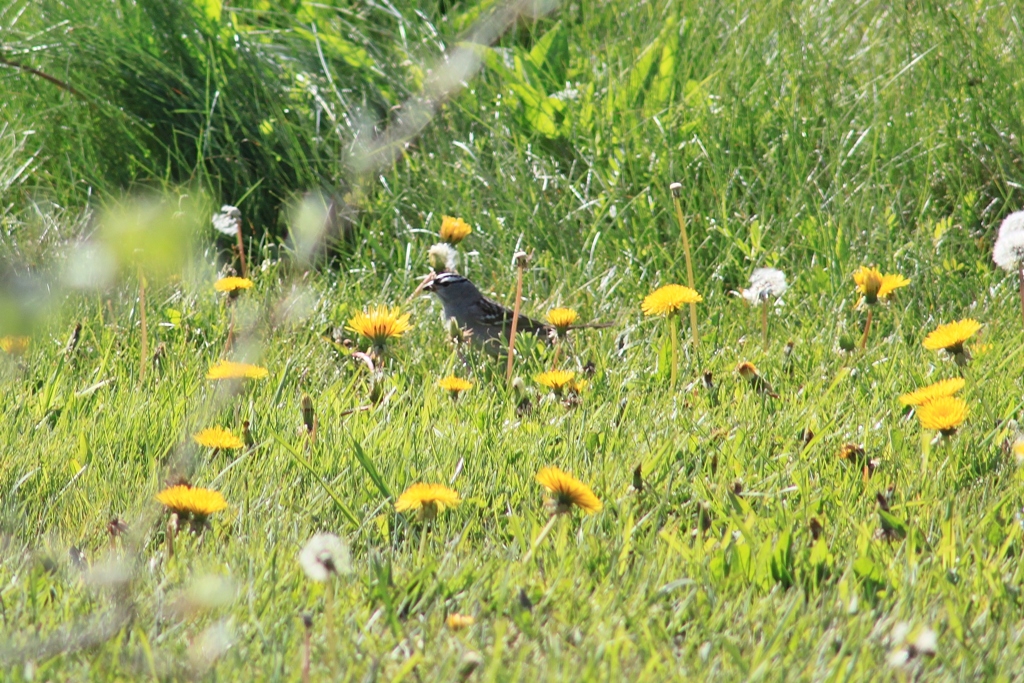
White-crowned sparrow eating dandelion
|
Another bird I don’t often get to see, let alone get to see well and be very cooperative, was a white-crowned sparrow that was very engrossed in those dandelions.
Now that I’m home again, I need to catch up on my cabin birding! When you’re a birder, as I am, May is no time to be sitting indoors.
Monday, May 07, 2012
Braddock Bay weekend
![]() |
| Braddock Bay |
May is always the best time to look for things outside, so even the few minutes we had was very productive. The first view today is where the bay meets the land. Miniature inlets and channels were everywhere and was great habitat for a variety of species.
![]() |
| Marsh wren |
The weekend also produced some other good sightings--palm warblers, a warbling vireo, white-crowned sparrow, third year bald eagle, sandhill crane. I'll write more about those tomorrow.
Wednesday, May 02, 2012
Can't top it
![]() |
| April 29, 2012 |
So perhaps that's why I didn't see the red fox earlier than I did. The fox was just off the left side of the trail and was climbing over a log and rock. I stopped dead, expecting the fox to bolt. Amazingly it did not. It kept coming towards me, no more than 15 feet away for at least another 4-5 steps. Finally, it did see me and faster than I could blink it disappeared into deeper the woods.
I went over to the spot where I first saw the fox, wondering if there was a den there. No den. I believe the fox was napping, though, in the sheltered area under the log that was resting atop a good-sized rock. Perhaps it heard my footsteps and got up to investigate, not realizing in those first moments that I was Right There. A few seconds later and from just across the stream, I hear the fox bark. The poor thing was probably complaining to its mate, "I had to move! I'm over here now!"
![]() |
| Jack in the Pulpit |
Jacks-in-the-pulpit (or is that jack-in-the-pulpits?) are up this week, too.
I found these odd fungus on my walk. At first I thought they were "expired morels," but photos I've seen of fading morels don't look like this, so I don't know what they are. Interesting fungus is about the best I can come up with.
I'm glad I took good advantage of the superb weather to traipse down along the stream this past weekend. The rest of this week has been foggy and humid, with spates of much-needed rain and occasional thunder. The rain is appreciated, but it's not the kind of weather that makes for great photos!
Labels:
jack-in-the-pulpit,
red fox
Monday, April 30, 2012
Blue and green
![]() |
| Showy orchis |
I headed down into the moist valley between Roundtop Mtn. and Flat Hill. I wanted to sit at the pond, explore the banks of the old road and look for a plant or a flower that I didn’t have in my drier woods up on the mountain. It didn’t matter what I saw, really, as long as I was out.
My first stop was the pond, and though I planned to sit there, I didn’t stay. The reason? A pair of wood duck startled at my approach and flew over to the far side, away from me. Perhaps they are nesting or soon to be, and I didn’t want to disturb that possibility. I walked on.
The woods are drier than I expected. Normally in spring, the old woods road has spots where the walking is all but impossible without a pair of Wellies. Today, Beaver Creek is running full and loud, but the road is dry, with not even a half-decent puddle to avoid. Water isn’t rushing off the mountain. The springs that drain off the mountain aren’t running. It’s April, the month of showers, and it shouldn’t be like this.
I find wild geraniums, violets, buttercups and rue anemone, all of which I have up by my cabin. The ferns are unfolding, if still smaller than they will be. They are reaching the point where I can identify them, though, which is further along than they were two or three weeks ago when I was last down here.
And then I find the flowers. Small, with a broad green leaf. Most are blue, but the shades run from almost-white to almost-pink to pale lavender. The flowers aren’t completely opened yet. And what is it? What is this pale blue flower. Showy orchis. A native orchid.
I found several plants, between 4 and 6 all together, all fairly close to each other.The top photo actually shows two plants together. Aren't they beautiful? I suspected this plant was here. I found the plants last summer, long after the blooms were gone, but the leaves were still there and looked right.
The plant is small, perhaps 8-10 inches across. The flowers are but half an inch or so. The orchid is uncommon but prefers rich, moist woods and is most often found along stream beds. The only other member of this orchid family is found in Asia, or so I've read. Unlike many orchids, this one is fragrant, though the aroma was still mild as the flowers aren't yet completely open.
A walk in the forest is always fun and always shows me something different. And there's always magic, too.
I found several plants, between 4 and 6 all together, all fairly close to each other.The top photo actually shows two plants together. Aren't they beautiful? I suspected this plant was here. I found the plants last summer, long after the blooms were gone, but the leaves were still there and looked right.
The plant is small, perhaps 8-10 inches across. The flowers are but half an inch or so. The orchid is uncommon but prefers rich, moist woods and is most often found along stream beds. The only other member of this orchid family is found in Asia, or so I've read. Unlike many orchids, this one is fragrant, though the aroma was still mild as the flowers aren't yet completely open.
A walk in the forest is always fun and always shows me something different. And there's always magic, too.
Friday, April 27, 2012
Mayapples and mornings
![]() |
| Mayapple blossom |
My latest record for mayapples was May 13 in 2009. Usually, the blossoms appear the first week of May. May 3-7 are typical dates. The mayapple in today’s photos didn’t have any umbrella-like leaves overtop to shade it. The stems looked as though the leaves were eaten off, as opposed to not having appeared yet. I suspect a rabbit.
Most of the animals I’ve been “seeing” around the cabin this week are really animals I’m hearing. I’ve heard turkeys gobbling somewhere over by the new pond and at least partway down the mountain. They gobble right at dawn and the sound is somewhat distant. I keep trying to pinpoint the location of their roost tree, but so far I haven’t narrowed the location very much. During the work week I don’t have time to go wandering down the mountain looking for turkeys, and on the weekends I resist getting up before dawn.
I’ve also been hearing a screech owl performing a call that’s not the usual descending screech. This call is more like a monotone screech or twitter. This morning the call was finally close enough to the cabin for me to be sure it wasn’t some other, rarer species of owl making the sound.
This weekend I will attempt to head down the mountain to walk along the stream, assuming I don’t encounter more mud than is hike-able, a possibility given that rain is predicted for tomorrow. I will look for turkeys or turkey scratchings and for flowers that aren’t the ones I see up on the hill where the ground is drier. I don’t plan to hike at dawn, though. Even the idea of seeing wild turkeys on a roosting tree can’t get me up that early on a Sunday morning.
Thursday, April 26, 2012
Brood is complete!
My new brood of chickens is now complete. I have my “old” chicks, which are now a bit more than a week old. Last night the new black chicks arrived. You can see the size difference. That’s how much the old babies grew in the last week. After seeing the new chicks and the old chicks together, I can also see how the old chicks are also stronger and more active than the newer little ones.
The new babies are still just a few days old and are still essentially pretty clueless about everything. They have learned how to drink water and eat food but that’s about the extent of their knowledge at the moment.
The newer babies are black, sex-linked chicks, which means they are a cross between a Rhode Island Red rooster and a Barred Rock hen. All my chickens do or will lay brown eggs. The color of a chicken’s egg shell is determined by the color of the chicken’s ear. Brown chickens tend to be larger than the white chickens raised by commercial growers, so the eggs are usually bigger, too. My old chickens lay jumbo sized eggs, so I can make a one-egg omelet that’s only slightly smaller than a two-egg omelet from a commercially grown white hen.
So far all the babies are doing well. The old babies weren’t thrilled with the arrival of the new babies, but that only lasted for 5-10 minutes. Soon, they were all getting along just fine.
Wednesday, April 25, 2012
Aurora Borealis??
Be on the lookout!
There a decent chance for aurora borealis tonight and especially tomrrow night in the lower 48. On the nights of April 23-24, northern lights were spotted in more than a dozen states, including Colorado, Illinois, Iowa, Minnesota, Michigan, Nebraska, Kansas, Wisconsin and both Dakotas.
Tuesday, April 24, 2012
Not a Snowtober
Roundtop Mountain didn’t get another “Snowtober” from the April nor’easter that pummeled the mid-Atlantic states over the weekend and yesterday. The storm produced about two inches of rain here, which was much needed, and I did see some brief snowflakes and a bit of sleet. The temperature stayed at 36 degrees all day, which was close enough to a snow-producing temperature to be a bit worrisome. Just an hour or two drive’s west of me the temperature was colder and those folks got a late-April snowstorm, about a foot’s worth. I’m glad this one missed me!
As it was, the day felt chilly and damp, with a cutting breeze. The rain drops stung like little bees on my face, but after the too-warm winter and few spring rains, even that seemed welcome. Indicative of how dry it has been here, those two inches of rain pretty much all soaked into the ground. Water wasn’t flowing down the gutters or ditches, and I didn’t even see puddles backing up around the storm drains.
A storm the size of this one pretty much put a halt to migration anywhere on the east coast. From what I can make of the migration maps this season, not much of the migration is taking the eastern route this year anyway. The show all seems to be in the central states, which probably explains why I haven’t found a single warbler yet this year at Roundtop. There’s still time for something to show up, but I’ve never had a year that’s waited this late before any arrived. That’s just one more thing to add to the already long list of weird things for 2012. At this rate, that list will be a tome by the end of the year.
As it was, the day felt chilly and damp, with a cutting breeze. The rain drops stung like little bees on my face, but after the too-warm winter and few spring rains, even that seemed welcome. Indicative of how dry it has been here, those two inches of rain pretty much all soaked into the ground. Water wasn’t flowing down the gutters or ditches, and I didn’t even see puddles backing up around the storm drains.
A storm the size of this one pretty much put a halt to migration anywhere on the east coast. From what I can make of the migration maps this season, not much of the migration is taking the eastern route this year anyway. The show all seems to be in the central states, which probably explains why I haven’t found a single warbler yet this year at Roundtop. There’s still time for something to show up, but I’ve never had a year that’s waited this late before any arrived. That’s just one more thing to add to the already long list of weird things for 2012. At this rate, that list will be a tome by the end of the year.
Monday, April 23, 2012
A new brood
![]() |
| the new babies |
So far the new babies are doing well. They were only a day or so old when I took this photo. They still aren’t a week old but I can already tell they’ve grown. Baby chicks are very fragile, so I’m not counting on all three surviving. I hope they will, of course, but it wouldn’t be a surprise to lose one at some point.
I’m down to four chickens from my original group of eight, who are now three years old. I lost one or so to sickness and two to predators. The rest are doing well and still laying pretty well, if not with the vigor they did two years ago. But the time has come to replenish my flock, and I hope these three will be the start of that.
When I got my first batch of chickens, I really knew nothing about raising chickens. I only knew I wanted fresh eggs. Since then I’ve had a lot of fresh eggs and learned a bit about raising chickens. Hand-raised chickens are sweet little souls, gentle and friendly. The eggs are so good I never want to go back to store-bought eggs.
For now the little babies are in my bedroom, warm under a brood lamp and learning how to be little chickens. They won’t be able to go outside and join the others until around mid-June. It will be August or September before they start to lay their first pullet eggs. It’s a long process from chick to fresh eggs, and getting the new babies is only the first step.
Friday, April 20, 2012
Shades of Purple
![]() |
| Wild Geranium |
2012 is producing a banner crop of wild violets, at least around my part of the forest. These deep purple flowers are everywhere. Don’t tell the other flowers, but I think the wild violets are my favorite—at least this year.
Rain is forecast for this weekend and into Monday, lots of it. Inches of it. Though no one wants rain on a weekend, my region is so dry right now that I’m not going to mind. Without any snow this past winter and few April showers this spring, the local rivers are already nearly as low as August. The soggy weather will likely put a damper on my hiking, birdwatching and photography—the three outdoor things I enjoy the most—but I’ll deal with it. The rain is much needed and will be welcome.
![]() |
| Wild violets |
Thursday, April 19, 2012
Losing the view
![]() |
| North of Carolyn's cabin |
The sprouting understory is hiding a view of a dirt road and several large trees that have rested on the forest floor for some years now. In another several days or perhaps a week, the tree canopy will be so full that I won’t be able to see the sky.
My view to the western mountains was gone last night when I got home to the cabin. Oh, I can still see a broken outline of it, but that’s mostly because I know where to look. Ah, winter, where were you? Summer, you’ve come too soon.
The good news for me is that I had a bit of rain yesterday. Not enough to get truly excited about, but when the rivers are already down 75% from where they should be at this time of year, even .1 inch is noteworthy.
Last evening near sunset, ahead of the rain but after the sky was already overcast, I was returning to the cabin when the sky turned the shade of a spring rose in bloom. I was hoping to reach someplace where the foreground would be reasonably interesting before I took a photo, but when the color started to fade, I simply stopped along the road where I was and took a shot of it. Color like that shouldn’t be forgotten, even if the foreground is forgettable.
![]() |
| Lisburn Rd. near Wellsville, Warrington Township, York County, Pennsylvania |
Wednesday, April 18, 2012
Dogwood days
Dogwood are now in full bloom on Roundtop. Today, unfortunately, is cloudy so you can’t see the full effect of half a dozen or so blooming dogwood trees. Still, even a gray morning can’t completely obscure their beauty.
Spring has reached that point where the grass is such a bright green it almost hurts the eye to look at it. Once the shade begins to fade and darken, I lose interest. This intense shade doesn’t last very long. For the past few mornings, a herd of 8 deer have walked past the cabin, just before sunrise, a few feet from a door or a window. They move slowly, tasting their way through the forest. They are quiet, with only an occasional footfall to give them away. Mostly, they ignore me even when I am outside. Sometimes one will look up and watch me for a few seconds to make sure I’m not doing anything they consider dangerous.
If Baby Dog hears or sees them she launches into a frenzied warning. She can’t ignore them, for some reason, though the deer are starting to almost ignore her. She makes them nervous, though, and they usually move a little bit quicker past the door. Sometimes one of the younger ones will flick its tail, but none of them do more than that. Perhaps that’s what frustrates Baby Dog so. She’s barking with that deep-throated warning for all she’s worth, and the deer can barely be bothered. I expect she’d be happier if her warning scattered them like dry leaves in a sudden breeze.
Tuesday, April 17, 2012
Passing me by?
![]() |
| Sunset with redbud in foreground |
As if to prove that, this morning I heard the first red-eyed vireo of the spring, and just as in other springs, trying to find that bird in the upper reaches of the oak canopy proved impossible. It doesn’t help that the birds are nearly the same shade as that of the leaves when the first rays of the morning sun turns them a bright yellowy-green. So this morning I had to be content with the vireo’s sharp, brilliant song emanating from somewhere high above my head.
Sometimes the internet is both a blessing and a curse. It is with growing envy that I am reading reports of outstanding migration flights into the central part of the U.S. It is with even more envy that I read about some 35,000 broad-winged hawks passing over Braddock Bay near Rochester NY yesterday. Here at Roundtop, I’m still hoping for warblers to arrive and perhaps to see a few raptors pass overhead. Right now the migration is feeling nearly non-existent, one invisible red-eyed vireo not withstanding.
I’m ready for those migration floodgates to open. I’m just starting to worry that they are passing me by this year.
Monday, April 16, 2012
Redbud and dogwood
![]() |
| Dogwood and Redbud |
The photo today also shows the current state of leaf development at Roundtop. It’s far more pronounced than it should be in mid-April. Cooler weather after the record-breaking temperatures of March did slow down the progress somewhat, but today is another near-record breaking day of heat that will likely get the leaves bursting again.
I still have something of a view around the cabin, but it’s lessening a little each day. In another week, perhaps two, it will be gone until November. For now, I'm enjoying my last views of the open canopy around the cabin. Soon, I'll have to walk out to the lane just to see what the weather is doing. Losing my view of the sky always takes some getting used to. I'm not there yet.
Friday, April 13, 2012
Buffleheads
![]() |
| Buffleheads - female and male |
Wednesday evening as I returned to the cabin, I found a pair of buffleheads on the old snowmaking pond at Roundtop. These small, diving ducks are common in winter on the bigger lakes and rivers in my area, but finding them on a small snowmaking pond is not. Once, last fall, I had a single male bird on one of the ponds, but this marked the first time I’d ever seen a female of the species here.
No more than an hour before I saw the birds, my area had a brief, intense, rain/snow/sleet/hail event (take your pick). I suspect these birds were migrating north when the storm hit, and the poor weather forced them down out of the sky.
I raced back to the cabin, grabbed the camera’s not-very-long lens and drove back to the pond to try for a photo. The photos aren’t the best as, compounding the lens issue, the buffleheads kept swimming to the opposite side of the pond to put some distance between us. That said, a car still makes a good blind from which to photograph birds or animals. If I hadn’t been in a car, the birds likely would have flown the moment I appeared at the bottom of the lane.
I took a few photos and then left the birds alone. They were gone this morning, as I suspected they would be. The weather had cleared, and they are likely on their way north again.
Thursday, April 12, 2012
Dogwood blooms
![]() |
| Eastern dogwood in bloom |
Roundtop is a forest filled with oak, beech and hickory trees, the kind of forest that produces nuts—acorns, hickory nuts, etc. And then spring arrives and along the forest edges appears this wild proliferation of blooms. For a little while it simply doesn’t look like the same forest.
So far, the dogwood trees here on Roundtop appear to be healthy. A fungus has damaged or killed many trees elsewhere. I look at the leaves and the twigs here on the mountain for signs up of it, and so far I haven’t found any. I hope I never do.
Wednesday, April 11, 2012
Redbud now, dogwood soon
The redbud trees around my cabin will soon fade out of their perfect pink and turn into spindly green-leafed trees, completing one of the few of nature’s transitions that goes from swan to ugly duckling (or, more accurately, to ugly cygnet). Today, they are still near their peak, but I’m already finding small, green leaves on the tips of the branches instead of their astonishing pink buds. So before they fade away for another year, I simply had to post a few more photos of them.
The first photo is along the road up to my cabin. The tree in the foreground stands at the base of the lane and is the first thing I see when I head up the road. The second photo isn’t as good but does show how that pink color is all through the forest right now. I can easily see 8-10 redbud trees in a small area at the bottom of the lane, and the pink just fills the forest.
This morning I also discovered that the flowering dogwood trees are beginning to flower. The flowers are not quite fully open, but the first of them should be out by tomorrow morning, so I will post a photo or two of them then.
This year I won’t have redbud and dogwood blooming at the same time. That doesn’t happen every year anyway. The dogwood typically follows the redbud by a few days or a week, but in some years when the weather is just so, I can find both blooming at the same time.
A few years ago the single dogwood tree at the bottom of my lane fell over. It chose to grow along the edge of the lane, roots exposed along the bank. Inevitably, that resulted in the tree losing its grip on the earth, and it fell over of its own accord. Dogwood trees are gorgeous but aren’t very strong. Since then no new dogwood trees have appeared in this spot to take its place. While I’ve looked elsewhere on the mountain to find redbud and dogwood growing side by side in hopes of eventually taking a photo showing a pink and white forest, I haven’t yet found them close enough for that. Maybe next year. I’ll keep looking.
Tuesday, April 10, 2012
Friends Meeting House
![]() |
| Warrington Friends Meeting House, just outside Wellsville, Pennsylvania |
West of the Susquehanna River, as York County is, not many buildings from before the Revolution are still standing. Not that many people lived here then, either, and most of those who did lived to the south in the city of York. In northern York County where I live, the land was still largely wild and shared with Native Americans. This area was still only partly settled in 1740-50, mostly by a few farmers.
Quakers were a predominant religion here then, not a surprise when you know that Sir William Penn, himself a convert, obtained a land grant from King Charles II and established a Quaker government here. Also nearby is a road named Quaker Race, which was so named because after meetings in this building, local young Quakers would race their horses and buggies along it. It’s a long, straight and flat section of road, and even in those days young men liked to go fast.
Today, the meeting house is a fine old building, well maintained, built from native field stones. It is on the national historic register and has certainly seen a lot of change and a lot of history over the past 260 years or so.
Monday, April 09, 2012
Moonset and sunset
Spring is well along now on Roundtop Mtn. I won’t have many more days before I lose the view to the west and will once again spend the next six months encased in the “green box” of foliage that covers my cabin.
I miss the open views of winter, though I appreciate that the dense canopy of foliage is the only thing that stands between me and the need for an air conditioner. Those layers of thin, green leaves prevent the sun from penetrating down to my cabin. The thermometer in my car shows a drop of 5-10 degrees as soon I drive under the cover of the forest.
Usually each summer has a week or so that has me questioning my lack of air conditioning, but then the humidity clears or the temperature drops, and I wouldn’t need the thing for another year anyway, so I do without. I suspect that choice will change once I retire and spend entire days in the cabin, instead of just my non-working hours, but that’s a topic for another year.
I miss the open views of winter, though I appreciate that the dense canopy of foliage is the only thing that stands between me and the need for an air conditioner. Those layers of thin, green leaves prevent the sun from penetrating down to my cabin. The thermometer in my car shows a drop of 5-10 degrees as soon I drive under the cover of the forest.
Usually each summer has a week or so that has me questioning my lack of air conditioning, but then the humidity clears or the temperature drops, and I wouldn’t need the thing for another year anyway, so I do without. I suspect that choice will change once I retire and spend entire days in the cabin, instead of just my non-working hours, but that’s a topic for another year.
Both of today’s photos were taken off the back deck of my cabin and show nearly the exact same views. The only difference is that the sun sets on the north side of Nell’s Hill and the moon sets on the south side of it. In the sunset photo, you might be able to see a few of the always spindly redbud trees just beneath the sun itself. In the moonset photo you can see the lights from the porch of my nearest neighbor to the west, which is about a mile away through the forest.
Soon my neighbor’s lights will disappear, as will the entire view of Nell’s Hill. It will be Halloween or later before they both reappear. I always look forward to that.
Thursday, April 05, 2012
Life in the woods
Roundtop is in the middle of a weeklong spate of nice weather—sunny, mild and windless. The evenings are cool, but that’s to be expected. If this weather continues for more than another week or so I will start to fret about the lack of rain, but I don’t need to worry about that just yet.
The comfortable weather makes working on the ever-growing underbrush that surrounds my cabin a comfortable chore before I start dinner in the evenings. The dogs help by walking alongside of me as I struggle with another armload. I take the brush down my driveway, across the lane and drop it in the woods over there. Just when I think I’m making some headway, the forest grows some more overnight, and I’m back to where I started again. The dogs don’t seem to mind that at all. They think following me back and forth is part of their job, and they are happy to have a job.
Baby Dog tends to take having a job too seriously, though, especially on nights with a full or nearly full moon, as last night was. The light from a full moon is bright, and I know she can see better under one. I don’t always know what she sees, but whatever she thinks she sees, to her it’s something that shouldn’t be there. Usually, the something is utterly harmless and has every right to be there. Sometimes it’s an opossum and most often it’s deer, but to her it doesn’t matter. It requires enraged barking, and that wakes me up.
And then I remember that it’s another full moon, and I had the same problem last time. Full moon equals Baby Dog barking at all hours of the night. And that equals me not getting any sleep. The objects of her barking are completely oblivious to her outrage, which only makes her bark even louder. How dare those deer ignore me, she seems to say. Tonight I will have to find someplace for her to sleep where she can’t see the outdoors. It’s the only way I’ll be able to get any sleep until the moon is small again. Such is life in the woods.
Wednesday, April 04, 2012
Flat
![]() |
| Appalachian April (Roundtop Mtn. version) |
I don’t know if my two dogs view the fox’s barking as coming from a fellow canine or not. Certainly, they see the barking as a dangerous interloper caused by a creature that is too close to the cabin for their comfort. And so they bark.
Later on during the night, I was awakened on two separate occasions, hours apart, by single, bright flashes of lightning, each followed by a single rumble of thunder. This morning, nothing was left of the mini-thunderstorms except for a partially cloudy sky. The cloud cover was the kind that made me think the sunrise might be especially nice or at least create an attractive light for a morning photograph. A good sunrise needs some clouds to make it interesting. To my disappointment, the clouds did not produce a pretty sunrise, and indeed the light stayed flat all during the early morning.
So at the last second I headed into the woods to see what else I could find to photograph. The forest is pretty in the early spring, though the flat morning light didn’t help it very much. The trees are starting to look fuzzy, and the understory is already somewhat leafed out. The redbud trees are still red, though the white dogwood flowers haven’t yet arrived.
I did find a few small plants of our native wild violet, a delicate flower that seems more pansy-like than a relative of the houseplant violet. In this area the deep purple flower is the most common shade. Violets like moisture, and don't mind a few stones, either. The plant is native throughout most of North America, though the color varies from purple to yellow to white, depending on the region.
It’s a shame the light wasn’t more cooperative this morning, but that’s how it goes sometimes. If I only took photos when the light was just so, I’d take precious few of them. I have to take the bad light with the good light. Nature keeps her own agenda in all things.
Tuesday, April 03, 2012
Between night and day
At 6 a.m. the sky above Roundtop is just beginning to show signs of the coming dawn. The black of night is fading to a steel blue in the east, with the barest hint of orange along the horizon. To the west the sky is still midnight black, and I can see the fading of the night move across the sky little by little. It is still dark enough for the great horned owls to call each other from somewhere up on the forested knoll, but it is already light enough for the first robins to sing and the phoebe to call.
This is the time that Baby Dog and I go for our morning walk, in this edge between dark and light, between morning and night. Twilight is neither fully day nor fully night. It is a time when both exist and neither. It is still night when we begin our walk but already morning by the time we return to the cabin. In another week at this time, the day will already dominate this hour, but for now, during this week, day and night are equal partners. And because both occupy the same time, I sometimes find it difficult to identify the sounds I hear. Is it a night sound? Or a bird from the day? Unlike the owls, I can’t always tell. Perhaps that is why twilight is more mysterious than other times. I just don’t know what I will hear, nor do I always know from which realm the sound emanates.
Baby Dog is unconcerned either way. A sound in the woods is something to bark at, regardless of the hour. Behind us, six deer gallop across a stone parking lot, hooves clattering, only their white tails visible. They run from night into the day and just that quickly, it is dawn.
Monday, April 02, 2012
Online free weekend
I spent my weekend free of online distractions, filling it instead not with music or some other distraction, but with the natural sounds and sights of the forest around me for company. Now that spring is here, the woods are getting noisier again and are a far cry from the silence of winter, even one in which that season never fully arrived.
The pileated woodpeckers are still screaming around my cabin, screaming at everything in sight, whether vulture or dog or blue jay or me. Nothing gets by them and everything is cause for alarm. I have seen them in two different nest holes. Perhaps the female hasn’t yet decided which she prefers. Her mate proves his devotion and protection capabilities for his future family by his near-constant alarm calls.
I’d rather be distracted by the pileated woodpeckers than by news that isn’t very newsworthy, weather news that doesn’t show anything severe or by music that hides the sound of these everyday woodland dramas. I also stopped reading my newspaper during and after breakfast so I can watch what’s going on in the woods outside my door. It’s one thing to bury my nose in the paper during winter when it’s too dark to see past the back deck, but now that the mornings are light again, the news of the woods is a lot more pertinent to my daily life than the latest goings on half a world away.
Distractions, unfortunately, are a part of life, especially modern life. And yet today I find myself resisting the pull of the technology. Something that takes my attention away from what is happening around me is something that serves to separate me from my own senses. Television or telephones or computers are like a shield that prevents me from fully experiencing the life around me. Even important information and beautiful music draw me away from that, making everything that’s at hand less noticeable. It’s not just cellphones that distract.
This morning before the sun was well up, the vultures were coursing through the air behind the cabin. Some are likely migrants taking advantage of the strong breeze. Others are certainly local birds, perhaps kept from foraging by rain that kept the air heavy during much of the weekend. The breeze was just right for these big birds, strong enough to help them move around, but not so strong as to make fighting it difficult.
Juncos are still in my woods. The warm spring is not yet urging them to head northwards. They are twittering their spring songs, though, so the trip north can’t be far away for them. Also singing now are titmice and chickadees, towhees and cardinals, to name a few. I looked for warblers this weekend on the mountain but didn’t find any. I wasn’t really surprised by that, even if it didn’t stop me from looking.
The leaves are peeking out a little more each day. It is early for that to happen. The cooler weather of the weekend does seem to have slowed that progression down a little bit for the moment. Warmer weather at midweek will likely speed the process up again.
The only way I know of to keep in touch with my own senses is to use them, to feel the air and see the wildlife and notice how the rising sun slowly uncovers the mountain each morning. Those things are real and are in front of me. I never want distractions or entertainment to get in the way of that.
Subscribe to:
Posts (Atom)