Tuesday, May 28, 2013

Memorials and Monuments


Soldiers National Monument - view of a soldier and the figure "History."  Two other figures, "Peace" and "Plenty" adorn the opposite side of the monument and Liberty is atop the obelisk.
I live near Gettysburg, Pennsylvania, and have visited the battlefield there hundreds of time in my life. First, I went with my parents. Visiting Gettysburg was our family’s preferred way of spending a Sunday afternoon. I played in Devil's Den from the time I was allowed to run around on my own, and we usually picnicked somewhere on the battlefield.  Now, I visit on my own. Gettysburg is crowded in any season of the year but never more so than in the summer. This year the town and battlefield will likely be even more crowded than usual, as 2013 marks the 150th anniversary of the battle.
As a local resident, I learned long ago that I preferred to visit at the least busy times. Winter is an especially beautiful time to visit. This year, with summer and the 150th anniversary fast approaching and the Memorial Day weekend a kind of unofficial start to the summer season, I figured I’d better get there before the rush or I’d have to wait until after Labor Day to avoid the crowds. I wasn't particularly successful in avoiding the crowds this time.

There’s a lot to see in Gettysburg and though I’ve been there so often, I still don’t think I’ve seen everything, and some things I haven’t seen in quite a while. Every time I make a trip here, I try to visit a spot that I haven’t visited in a while or some place where I haven’t spent as much time as I’d like. This time, befitting Memorial Day, one of my primary stops was the national cemetery, where President Lincoln gave his famous address.
It’s been quite a while since I walked in the cemetery, and I’d forgotten some important things about it. Perhaps the first thing I noticed was that soldiers from other wars are buried here too. I saw graves from both WWI and WWWII, and if soldiers from more recent wars are buried here, I didn’t see them. Two graves from WWII, side by side, were noteworthy. The death date for the grave on the right is December 7, 1941 and the grave on the left is June 30, 1945. Those two deaths mark the start and nearly the end of that conflict.
The other thing I’d forgotten was just how many graves of the unknown there are here. Nearly half of the Civil War soldiers buried here are unnamed. Sometimes the graves are marked Union or Confederate unknown, sometimes the name of the unit is printed on the gravestone, sometimes the state where the soldiers came from is marked but mostly the graves are simply Unknown. Hundreds of graves, perhaps even more, are marked this way.
On a stone from Maine, marking 104 bodies, was a small homemade wreath made of dried pine needles and a note, which reads, “To the brave sons of the Pine Tree State who gallantly fought and died here so long ago. You are not forgotten by the students of Riley School, Rockport, Maine.”
Tomorrow: I'll share photos from another part of my afternoon.

Wednesday, May 22, 2013

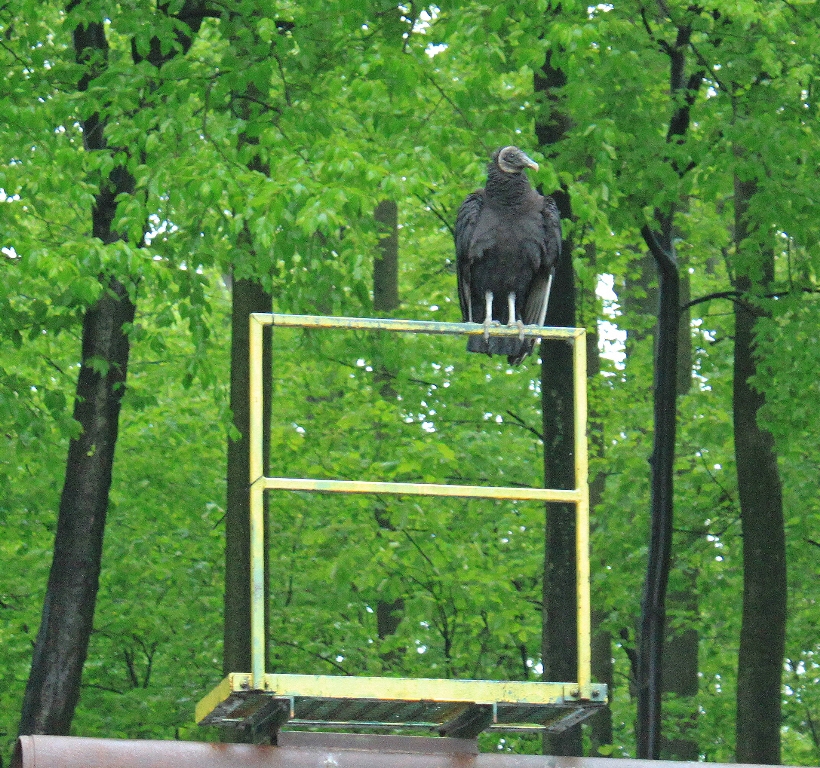
Both vultures practice vulturing


Black vulture (bottom) and turkey vulture (top)
 The air was so thick and heavy yesterday that even the vultures were brought to ground. Instead, both black and turkey vultures hung out around Roundtop’s dumpsters. Perhaps they figured that since they were grounded, they might as well hang out where they could still find some pickings. Or hoped to.


The black vultures seem less shy and slower to leave a food source than are the turkey vultures. The turkey vultures hopped over to the roof of the nearby maintenance building as soon as I pulled up to their dumpsters. The black vultures didn’t budge when I got out of the car and closed the door and only deigned to move when I got within several feet of them.


Black vulture

Black vultures are supposed to be a bit smaller than turkey vultures, but I can’t say that I notice that. They are much the same size as far as I can see. Lots of vultures ply the air around Roundtop, both kinds. They roost on or near the mountain on most nights. Once 20 of them roosted atop my cabin roof and the old TV antenna. I live only about 20 miles from Gettysburg, site of the famous battle, of course. There, witnesses told of masses of vultures for months after the battle, and to this day the battlefield boasts many, many vultures. Once the big birds found that spot, they didn’t want to leave, apparently. At this point, 150 years after the battle, I do have to wonder what keeps so many of them there. Perhaps that congregation of them contributes to the large numbers I have at Roundtop.


Tuesday, May 21, 2013

More newbies


New babies are sprouting up all over the place. Last evening I passed a herd of Thoroughbred mares with their new foals enjoying a warm evening in tall grass. The local Canada goslings that ply the ponds around Roundtop are already getting large. The first brood is already the size of my smaller chickens, albeit chickens without feathers.

I haven’t yet seen any new fawns, though I am still regularly seeing deer. Often, my sightings aren’t much more than eyes shining by the light of my headlamp. Last night Baby Dog and I heard and saw four deer, none of them small enough to be fawns. We walked out my driveway to reach a patch of open sky, so I could take a last look at the sky before heading back to the cabin. As I stood there I heard the rustle of motion in the forest on the other side of the lane. At first I only caught momentary glimpses as the deer moved down the hill towards me. I watched the glint of their eyes as they passed in front me and kept moving further down the mountain and through the forest. Sometimes the underbrush hid the eyeshine entirely, sometimes I could see them looking at me as they walked.

They thought they were invisible, of course, and except for the eyeshine, they were. Baby Dog listened intently, though I’m not sure she saw them any better than I did. The deer kept moving though at an unhurried pace. I suspect they were heading down to the pond for a drink. They usually wait until dark to come out of hiding and search for water. They are sneaky about it. I have rarely seen a deer at the pond. I think they aren’t there very long. They come down, slake their thirst and then immediately return to the safety and cover of the forest. Invisible again.

Monday, May 20, 2013

Weekend warblers (and a calf)


Calf investigating a tractor
 A few warblers finally showed up around the cabin this weekend, pulled out of the sky no doubt by the fog and drizzle that pervaded the weekend. I saw several American Restart and a Black-and-white warbler. Both species have visited the cabin in other years and both are among those that I’m likely to see here. Some warbler species are more likely to stop at my woods than others.

I’ve yet to see worm-eating, Wilson’s, orange-crowned and several others at the cabin. Black-throated green is usually common and Blackburnian isn’t unheard of. For several years black-throated blue was common, but I haven’t seen one of those lately.

The fog and drizzle of the weekend kept the skies gray or invisible most of the time. The warblers weren’t inclined to attempt to migrate through it. Instead, they spent the weekend around the cabin throughout most of the day. Birders typically get up early during warbler season to catch a glimpse of our little jewels. This weekend that wouldn’t have been necessary. The gloomy weather kept the birds around all day, even into the middle of the afternoon. They also didn’t seem to mind my presence very much. When I was outside I was moving around from one chore to the other and the birds weren’t fearful or shy. I wondered if the calm presence of my chickens outside their pen and foraging made the warblers feel safe enough to ignore me.
"Can I have the keys?"
I did hear a yellow-billed cuckoo this weekend, which is always a treat. The bird never seems close to the cabin, but the sound of that odd call travels a longer distance than do most. Sometimes the bird sounded as though it was high up on the mountain. Sometimes it sounded down along the lower slope, but never did it sound close enough to attempt to look for it. I had to content myself with listening to its haunting call. Maybe one day that call will be close enough to the cabin to make it worthwhile to attempt to find the bird.

Thursday, May 16, 2013

Forest life


That’s the last of them! This morning the eastern pewee’s plaintive call echoed through the forest around my cabin. The pewee is the very last of the summer residents to arrive. So now everyone who normally should be here is here. Oh, I could have another one or so. Some years I have a yellow-billed cuckoo somewhere on the mountain. I suspect that poor bird has yet to find a mate, at least here on Roundtop. The calls echo throughout the summer, moving from spot to spot as though hoping for someone to answer. Maybe someone did answer, eventually, but I don’t think it was here on Roundtop.


So now, instead of trying to find new summer residents, I can relax, pull up a chair and...No, that’s not going to happen. I have a list of outside work that’s longer than my arm, starting with trimming back the various tree branches and bushes that scrape the sides of the car as I travel my driveway. Just because I don’t have a yard doesn’t mean that there’s no work to be done. It can be a near-constant fight against multi-flower rose, poison and assorted saplings determined to take hold and cover the cabin.

It can be tough work, particularly when it’s hot outside, so now is the time to get at it. Some years it gets hot so early in the season that I don’t really get it done to the point that I’m relatively happy with it. This year so far, it’s been fairly cool, so at least I don’t yet have that to deal with. Still, it’s something of a race to get done, because I know summer’s heat is only a few weeks away.

I use hedge clippers and a longer handled clipper rather than a weed whacker. I used to have a weed whacker. Several, in fact. None of them lasted very long. I couldn’t handle the heavy weed whackers and the lighter weight ones didn’t hold up. I’ve had the clippers for years. I don’t mind that this is a battle I will lose. My only goal is to keep the tendrils of new growth from scraping the car along the driveway or me as I walk around the cabin. The forest will win, eventually. So be it. In fact, I hope the forest does win, eventually. If not now then at some point, even if that time is far into a future I will never see. I have faith in the strength of the forest to survive even mankind’s mindless destruction. Though I also believe that mankind would survive longer than I expect they will if there were more of us who believed in the importance of forests.

Wednesday, May 15, 2013

Wild Geraniums in bloom


Wild geranium
More spring flowers! Today the first of the wild geraniums are up. They qualify as one of my favorites. That lovely pale purple shade isn’t common on the wildflowers around Roundtop. That alone makes their presence welcome.

Wild geraniums are a small flower. Even with that unusual shade they can easily be overlooked. I first saw this bloom last night as I was walking Baby Dog. I checked the surrounding landmarks and then returned later with my camera. And I still spent a minute or so looking for it.

The near-frost I had in the morning didn’t hurt the plant any. In fact, none of the woodland flowers that are out right now were bothered by the 30 degree drop in temperature. Perhaps it’s only the cultivated flowers that are less able to withstand big drops in temperature.

So far this May has been cooler than most. I don’t mind that in the least as long as whenever the seasonal warm-up finally does arrive it doesn’t appear all at once. I hate those years when I have to turn off the heat in the morning and turn on the air conditioner later that same afternoon. This year my heat is turned off, but the overnight chill was enough to make me, momentarily, re-think that choice. Instead I opted for a sweater and another cover on the bed, where I was eventually joined by every cat in the house. Amazing how quickly they want to sleep with me when the night is a cold one.

Tuesday, May 14, 2013

Don't wait!


Along N. Wharf Rd., Monaghan Twp., York County PA
May is a lovely time of year for an evening walk. I have nothing against walking in other months of the year, though some of them present difficulties for those of us who aren’t retired or independently wealthy.

Walking in winter’s darkness can have its charms, though that can pall before the light returns to the evenings. A little bit of nighttime walking is fine, but I find six months o f it not nearly as interesting or enjoyable. A winter’s walk in daylight is still restricted to weekends for me, and those are busy enough that a daylight walk feels hurried, crunched in between this errand or that one.

In July and August, morning walks are preferable as the day’s heat takes all night to dissipate. An evening walk then can sometimes be hotter than one in the middle of the afternoon. Summer’s heat is hardly conducive to an enjoyable foray. And there are the ever-present evening storms to contend with, too.

But May is one of those months where daylight stretches on for hours and the temperature is pleasant and even a bit cool as dusk approaches. What could be finer? I think it’s the best month for walking. October has its charms and the temperature is usually fine, but the evenings are already growing quite short. No, May is the best month for an evening walk. The day’s work is done, the dinnertime chores are done, and daylight still beckons me outside. It’s enough to make me wish for May to last for months. Hurry! Don’t tarry or you’ll miss the best walking time of the year. We’re already halfway through the month. Don’t waste another day of it.

Monday, May 13, 2013

Wet weekend

Mayapple
More flowers and more birds are making their first spring appearances around my cabin. Alas, none of the birds were warblers. However, that doesn’t mean I haven’t had any good ones. A male scarlet tanager seems to be taking up residence right by the cabin’s north side. I was treated to his sweet song all weekend long and saw him a few times as well.

I frequently see scarlet tanager deeper in the forest. Down in the valley between Roundtop Mtn. and Nell’s Hill they are regular summer residents. I’ve never had one so close to the cabin before, though, so I’m quite enjoying his presence. I haven’t yet seen him with a female so I don’t know if he will end up with a nest nearby or not.

The blue jays that are nesting on the south side of the cabin must have hatched. I no longer see mom’s head or tail constantly poking up out of her stick nest. The babies, if there are any, aren’t yet big enough for their heads to appear above the edge of the nest.

The first wild geraniums have appeared and, as you can see, so have the first mayapple blossoms. Mayapples are difficult to photograph. The flowers are usually hidden under the umbrella-like leaves, which means I have to get down on the ground to get a photo. That’s not so bad, but at least at my cabin, wherever I see mayapple blooms, I also find poison ivy. You can see one of those on the left side of today’s photo. I’ve already had all the poison ivy I need for this year. A few weeks ago before the leaves of anything were out, I pulled up some stray twigs and roots and ended up with poison between my fingers. That was not fun at all. I know enough to wear gloves most of the time, but I wasn’t thinking that those bare roots might be poison. Now I know.

Friday, May 10, 2013

Dogwood in flower

 Dogwood blossoms are hard for me to photograph. The lowest blooms are usually well over my head, and the sky in the background doesn’t always cooperate either. This week the sky has been especially gray—not the ideal background for a while flower. This morning the sky was a bit more cooperative, and besides if I don’t get a photo of the flower soon, I will miss them this year.


I am impatiently awaiting the arrival of warblers, and I’m starting to think my fear that they will overfly me this year is what is happening . Certainly, I haven’t had anything other than a few yellow-rumped warblers. This morning I stood outside the cabin and listened to the dawn chorus, hoping for the sound of one at least. The chorus was filled with the sweet songs of many wood thrush and ovenbirds, but nothing that sounded warbler-ish to me at all. It feels ungrateful to complain while the wood thrush are filling the woods with their songs.

Wood thrush songs seem to emanate from everywhere and nowhere in the forest. The sound surrounds me, though the birds themselves are often invisible. Sometimes I can place them in this tree or that one, but that usually doesn’t help me find a bird that’s sitting deep in the tree. Occasionally they will sing in the open where I can see them, but that isn’t typical. 


Wednesday, May 08, 2013

Bird migration at its peak!

This week will be the biggest birding week of the year. It’s the week when migration explodes and millions of songbirds and summer residents head through the lower 48. Indications are already that birds are moving through the Central and mid-Atlantic. Many summer resident birds are here already, of course, though this week is still the biggest single time of the year for birds to move.

Unlike fall migration, which is spread out over a longer time, often with males, females and immature birds heading south on different schedules, spring migration is all about finding the best habitat for the best nest site and doing it before anyone else gets there or takes the best spot. Here in the northeast, we’ll have to wait for the low pressure system that’s sitting over top of us to move before the action really takes off. Last night, radar of the DC metro area showed a big concentration of birds, as did central Kansas.

Here at Roundtop, you can see what the sky looked like this morning—foggy, with rain expected off and on all day. It’s the kind of weather where birds like to sit and wait for conditions to improve. In a way, the concentration of birds in DC may prove to be unlucky for me just over a hundred miles or so to the north. Birds can cover 100 miles in several hours of flying; they may not stop here this year. It may be that only the birds who come for the season will land. The birds that we only see during migration may well not be ready to stop for lunch, let alone for the night, at the point when they will be over top of my cabin.

The serious bird radar watchers (or is that serious radar birdwatchers?) suggest that this year fewer birds are to be found anywhere on the trip north. Their radar spikes aren’t as concentrated or as large as is normal. I haven’t yet heard anyone discuss what that means—an ordinary variation in numbers, a sign of trouble in the wintering grounds. So I will try and resist the temptation to speculate and will instead just note it for the future. 

Tuesday, May 07, 2013

Surprises

Jack-in-the-pulpit
The view of the mountains to the west of my cabin is already obscured by spring’s new foliage. It will be November, a full six months from now, before I am able to see those hills again. The leaves first began to appear slowly, but once they started to bud the change to leaves was rapid. Even so, the canopy isn’t nearly as dense as it will be in another month. To the north, I can still see through the forest, a bit, to the sky. By summer’s solstice that will disappear, too. For now, I am enjoying what view of the sky I have left.


A couple of things about spring have surprised me this year, though after all the years I’ve been on the planet, I wouldn’t have guessed I’d forget something so obvious so easily. The first is the sound of the breeze through the leaves. The sound is entirely different than the sound of winter’s wind through the trees. My first thought when I heard the breeze was that the wind must be a lot stronger than it looked, to make so much noise. Then I realized that I hadn’t heard that sound for roughly 180 days, so it seemed new to me again. It doesn’t take much wind to make a summer breeze sound noisy compared to winter. All those thousands or millions of leaves rustle loudly on even the lightest breeze.

The second thing isn’t quite so much of a surprise, but a pleasant remembering. It’s nice to get up in the morning and have it not be dead dark outside. Even at 5:30 a.m., when I get up, daylight is now apparent. It’s not sunshine and it’s not yet very bright, but it’s light enough to do without the headlamp and that’s a nice thing. It seems so much more civilized to get up when the day is already producing some light. In midwinter, that 5:30 a.m. alarm seems as though it’s going off in the middle of the night.

My photo today is the first jack-in-the-pulpit that I’ve found so far. They are a pretty little plant but seem to want to grow around poison ivy, so getting a photo of one without having to tiptoe around poison requires careful reconnaissance before attempting a photo.

Monday, May 06, 2013

New arrivals--all kinds


Tiger swallowtail on lilac bloom

The first goose babies have arrived! The Canada goose pair closest to my cabin just fledged a clutch of six babies. I saw them the first morning they appeared and saw them take what may well have been their first swim. Two days later all are still doing well. One might be a bit smaller than the others, but even that one seems healthy enough at least for now.
I also saw the first tiger swallowtail of the new year, here perched atop a lilac bloom. I took this photo with my phone at my father’s farm. I thought it might be a tad early for the first tiger swallowtails to be appearing, but I checked NABA, the North American Butterfly Association website, which does keep track of such things. There are no sightings recorded from my immediate area, but as best I can tell from other sightings in the surrounding states, May 5 is about right for here. The lilac blooms? Perhaps a tad early. I think of them as a Mother’s Day bloom and we’re not quite there yet.

6 new goose babies about to take their first swim

I saw three yellow-rumped warblers flitting through the trees around the cabin on Saturday. Yellow-rumped warblers are pretty little things, but they are by far the most common warbler that passes through. More than one birder I know finds yet another sighting of them kind of disappointing. “Anything but another yellow-rumped” is a comment I’ve heard more than once. Roundtop is not a great warbler spot, so I’m not quite so jaded. For a while I was thinking I wouldn’t have any warblers to report this year, so even a yellow-rumped warbler is something of a relief. Still, now that I’ve seen them, I will be happy to see any other warbler than is not a yellow-rumped.
The rest of my summer birds are mostly here and singing. The wood thrush have arrived in numbers, as have the ovenbirds. The only voice missing from the usual chorus is the eastern pewee, always the last to join the crowd.
The weather was gorgeous here this week, though I feel as though I didn't make the most of it as I should have. I was about to leave for a walk when a chicken mini-crisis occurred. At the time, I thought it was a full-scale major crisis and that one of my girls had been snatched in broad daylight by something, probably a fox as I couldn't think of anything else that would snatch her without a trace and be gone in seconds.  Doodle the rooster made frantic warning sounds. The other girls rushed to the juniper bush and hid, gathering together in a pile making themselves as flat as they could.  They were scared and wouldn't come out, not even for me to put them back into their pen.  Doodle wouldn't quiet down for the longest time.  I was convinced I'd lost another chicken. And then after an hour, she strolled out from under another bush. She was hiding too, but by herself and across the way from the others. So what scared them so badly?  I have no idea.  All are safe and all of them are inside today.

Thursday, May 02, 2013

New birds and April temperatures


Nice patch of rue anemone

The first wood thrush has arrived, a dim and distant trill somewhere behind my cabin. I knew it was time. The ovenbirds arrived two days ago, and wood thrush are always close on their heels. The ovenbirds are always first, often by just a single day but never more than three days ahead of the thrush. This year the birds are actually later than is typical. My most common arrival dates for them range between April 23-27, so May 1 is a couple of days behind schedule at Roundtop. I’ve been listening for them, too, so the later date isn’t because I wasn’t paying attention.

I also heard the first blue-headed vireo last night. I never did see it. It’s a good thing the bird was nearby, even though still invisible. I have a difficult time differentiating the red-eyed vireo from the blue-headed vireo by their songs as they sound very similar to me. If the bird hadn’t been nearly overhead I’m sure I wouldn’t have identified it as anything more specific than a vireo species. As it was, I was glad the bird sang happily for a few minutes so I could be sure.

Wild turkeys continue to gobble and fly and run and scatter all over the mountain. At the moment they are more common than deer, many of which are hidden away and birthing the first fawns. The turkeys on the other hand are seriously courting, and the toms don’t care who knows it.

Redbud
On an entirely different topic, last evening I was examining the average April temperatures from Harrisburg since 1935 and found something interesting. In the 1930’s and ‘40’s April’s average temperature varied much more than it has over the past 20 years or so. Earlier in the 20th century, the average temperature often varied by more than 10 degrees from one year to the next. For example the average in 1942 was 55 (high even today) but in 1943 it was just 45. Year to year variability back then was quite often 10 degrees, sometimes more. Over the past 20 years or so, that variability has much diminished and the monthly averages now rarely vary by more than 6 degrees. The temperature average itself is trending higher—certainly those low April averages in the mid-40’s seem to be a thing of the past—but the range is noticeably less.

April 2013 was higher than the average of all Harrisburg April records by nearly a full degree, but only slightly higher than the average from 1981-2010, which are the only years that meteorologists use to calculate what they consider the normal temperature they are always talking about. 2013’s higher result was almost entirely due to 3-4 days early in the month that zoomed near and into the 80’s. If not for those days the monthly average would have been slightly before average, but those days were so extreme they skewed the entire month.

Wednesday, May 01, 2013

Comings and goings


Spring is a dramatic time, with new blooms opening virtually every day. Yesterday, the first of the native purple violets began to open. Tiny, with a deep shade of purple not seen in any other flower, the violets are still easy to overlook unless you happen to have a good-sized patch of them in front of you. When the plant is a singleton, in amongst the twigs and pebbles, they can be easily overlooked.

And while it’s easy to focus on the newest bloom of the week, it’s easy to overlook the blooms that are already fading. Bloodroot is gone the fastest, with only a day or two to bloom. But now the first bloom of spring, the coltsfoot, is done too.

Even as the blooms fade, the seed tufts of coltsfoot still resemble the dandelion that it is often mistaken for. The fuzzy tufts are not pure white, as are those of the dandelion, and the centers still retain a bit of their bright yellow blooms. But you have to look close to catch the difference.

The biggest difference is that even at this stage, the coltsfoot has yet to produce leaves. The leaves will only appear after the bloom stalk is gone. And that’s where the biggest visual difference with the dandelion is. The coltsfoot’s leaves don’t look anything like that other plant. If the leaves appeared with the bloom few would mistake the one plant for the other. But once the blooms are gone and the coltsfoot's leaves finally appear, there’s nothing about the leaves that are interesting enough to stand out amongst any of the others in the near-carpet of greenery that is the forest’s floor.

Tuesday, April 30, 2013

Odds and ends of spring


Nell's Hill, April 28, 2013
In addition to the redbuds, assorted other spring activities are taking place around the cabin. Wild turkeys are more common than deer at the moment. I hear the toms gobbling every morning, and hardly a day goes by that I don’t see turkeys parading in some field or another. Turkeys fly across the road in front of me, and people who’ve never seen a wild turkey before are seeing them this week.


Several summer residents have appeared as well. I’ve heard the first eastern towhees of the season and seen the first brown thrasher. A few warblers are trickling through, but never yet when I’ve had binoculars in hand.

My photo today shows the fuzzy trees of spring. Fuzzy is how I think of them as they are starting to leaf out. The photo was taken on Sunday, as it’s been raining, foggy and overcast since then. I’m not complaining about that. April hasn’t brought many showers this year, and the year’s precipitation is already running more than two inches in arrears. The drizzle of the past two days won’t erase that, but at least it’s helping a little bit.

Rue anemone must be at its peak of blooming right now. The forest floor is covered with the tiny white flowers around my cabin. It’s a very good year for them, at least if the numbers I’m seeing are any indication.

I’m still waiting for the local geese to hatch their clutches of goslings. So far I haven’t seen any of those, and the females are still hugging their nests. The female blue jay is also on her ratty nest of twigs and sticks full-time. She hasn’t been on the nest for more than a week yet, so she’s barely halfway through incubating her eggs. I am guessing that they will be due to hatch about May 9 or 10. The goslings should be out before that, likely within the next week.

Monday, April 29, 2013

It's redbud week


Redbud is at its peak this week. Although it looks like a flower, the pink is actually the leaf bud. And when the leaves are fully out, the tree is green like any other tree and not very attractive. It’s a spindly, weak and unhealthy-looking tree. That same spindliness is attractive when the tree is in its pink phase, but not very for the rest of the year.

Redbud also prefer the edges of the forest and are inclined to grow in poor soil where nothing much else is happy. I’ve often wondered how many trees are cut down simply because people are culling weeds and “improving” the edges of their property and don’t realize that the spindly, unhealthy-looking tree they just cut down shows beautiful color for a week or two in spring.

The spindliness makes for interesting shapes when the twiggy branches are covered with pink buds. Unfortunately, the rest of the time the tree just looks spindly. I found it difficult to photograph a redbud among the rest of the forest trees. The rest of the photo always contained water pipes or other detritus from Roundtop. If there was junk around, there was a redbud behind it. The tree just prefers spots that other trees won’t grow in.


Thursday, April 25, 2013

Morning ramblings

American beech
This morning I heard three calling eastern phoebes while standing in one spot. One to the right of me, one to the left and the third overhead. They seemed to be engaged in a round robin (pun intended) of “fee-bee”ing to see which could out “fee-bee” the others.


The blue jay nest that I found last week appears to be finished and doesn’t look any better than the mass of sticks it was when it was still a work in progress. This morning, mom blue jay was on the nest—I could see her tail feathers sticking out of it. As the nest is high, I can’t tell if she was intent on laying an egg or already incubating her clutch.

Yesterday, one small and unknown warbler was flitting around on the other side of the lane. As I was letting the dogs out after returning home from work, I did not have my binoculars in hand. Dogs and binoculars do not go well together, so the warbler remains unknown.

My photo today is of one of the three large American beech trees in my front forest. This one could be a bit larger than the other two, but all are very nearly the same size. I can’t photograph the entire tree in one photo because whenever I back up far enough to get all of it in the same shot, the other trees around it begin to obscure it. It is a lovely and venerable beech tree, with small sapling beeches all around it. Most of those won’t survive, as they can’t compete with this large tree for light. Those little trees won’t get their chance until this large tree has had its century or two and no longer dominates.

The tree is more than twice the height of the cabin and way too big for me to circle the trunk with my arms. It’s always been my favorite tree at the cabin, rising straight and tall, past the tulip poplars and even some of the oak trees. I’m sure it’s more than 100 years old and is easily going on 3 feet in diameter. Someday I should measure its trunk so I can tell you exactly how big it is. But that’s a topic for another day.

Wednesday, April 24, 2013

Precarious

****Stay alert for the possibility of northern lights tonight. The sun is unsettled right now and the aurora is possible in the mid-latitudes.****

Of course, here on Roundtop, thunderstorms are marching across Pennsylvania, so it’s unlike my sky will be clear enough to look. That tends to be the rule rather than exception on the few nights of the year when the aurora borealis is likely this far south.

Around the cabin new growth, new blooms appear every day. Last night I saw the first poison ivy along the edge of my lane and the driveway. I keep hoping, to no avail obviously, that the forest canopy will soon make it too shady for these plants. But, of course, the cut for the driveway and the lane lets in the sunlight and so up jumps the poison ivy.

The fern in today’s photo has grown in the crack of this boulder for years now. It is starting to feel like an old friend, and I look for it whenever I pass. It is not on my land, and indeed is right along the edge of the lane. Even a minimal widening of the road would displace it. Its long-tern survival is thus rather precarious, but every time it lives to see another spring feels like a small victory. The fern never gets bigger and is always in the same part of the boulder’s crack. It is a survivor against all odds. It’s one of those things I try to enjoy when I see it and try not to look too far ahead into its future. Some days that’s easier than others.

For some reason, the ferns that grow profusely just 150 yards away are near-strangers to my part of the mountain. Where I am is drier, I suspect, and the soil probably less rich. Still, the divide between the ferny part of the mountain and the non-ferny part is nearly complete, so I welcome this little one to my part of the mountain. I only wish there were more around the cabin, though I will be the first to tell you that it isn’t much of a walk to enjoy several varieties of ferns in large numbers.

Tuesday, April 23, 2013

The state of the spring

The landscape is opening up to the spring season here on Roundtop this week. The redbud are starting to turn pink, though are still not near their peak of color. The dogwood really aren’t ready to bloom at all just yet.


The grass has turned from a greenish brown to a brownish green and now finally fully to green. The geese are incubating clutches of large, white eggs on ponds all around the mountain, each pair to its own pond, with assorted honking battles for prime territory still sounding off most evenings.

The American beech trees have miniature leaves at their edges. The old oaks are nearly as bare as during midwinter. Nothing hurries them. They will leaf out when they are good and ready.

Blooms of rue anemone dots the forest floor, and the mayapples will soon flower. Swallows have returned to ply the ponds for insects. The dawn chorus of singing birds grows louder by the day. Spring is well and truly here and well settled in, as well. This is to be expected as we are already a month into the astronomical season, a full month past the vernal equinox.

Here, April will likely end up being warmer than normal, due mostly to three days that were profoundly warmer—by 20 degrees!—than is typical. The rest of the month has fared in the normal range, even cooler than is typical, but those three warm days simply overpowered the rest of the month. As you can see, the sky is overcast in the photo taken this morning. I’ve had some clear days, but overcast has been more the norm than the exception. Though I am more than 100 miles from the ocean, today’s overcast is the result of an east wind, bringing in a marine layer of clouds.

And there’s been rain during the month but not enough to make up a 2 in. deficit. I think of a typical April as one with many April showers. I remember some Aprils as a constant drizzle. That has not been the case this year, though I’m not sure I like the overcast skies much better.

Last year May was the month of showers, not April. As rain has not much materialized this month, I am rather hoping that they will come in May. It’s not that I like a usually pleasant month like May to be clouded by rain, but if we don’t get a hefty amount of it in May, it’s likely to be a long, hot and dry summer. And I’d like that even less than rain in May.

Monday, April 22, 2013

Happy Earth Day!


Sunset aflame - view from back deck April 21, 2013
Happy Earth Day!


Every day should be Earth Day. That said, if there’s any day to make an effort to get outside and observe the natural world around you, today should be that day.

I celebrated early, as in yesterday, because of the weekend. I packed up my binoculars and my scope, took a few snacks and a cup of coffee and went outside to see if I could find any migrating hawks. Earlier in the week I had some hope that Sunday might turn out to be a good migration day. By the time the day rolled around, however, the calm winds turned into a 17 mph wind and worse, that wind was from the ENE, certainly near the very bottom of the worst possible directions for a spring hawk count. But I went anyway.

Early in the day I did see a few hardy migrants, likely birds that roosted in or around Roundtop before continuing their northward journey. An Osprey was perched atop a zip line pole, waiting for fish. One of the local redtails soon appeared, looking for breakfast. A Cooper’s hawk zoomed by, intent on some prey in the cover of the forest.

The first barn swallows put in an appearance and a few more tree swallows were added to my season total. The crows were riled up about something, as were the blue jays. A light frost had occurred overnight, and the wind made the temperature feel just this side of brutal. I stayed until my gloved hands started feeling numb. By then, the early morning rush of birds had slowed, and I was ready for a cup of hot chocolate!

Thursday, April 18, 2013

Early spring forest

Rue Anemone
This must be flower week for Roundtop. The spring ephemerals are popping up all over the forest. Today’s flower is rue anemone, which has gone from just a few blooms to dozens, if not hundreds of them, all around the mountain. These are small plants, no more than 4-5 inches tall, and if you are not careful, you can easily step on them. This was a nice little bunch of them. Often, only a single flower is seen or perhaps two. Sometimes I come across a small patch of them, where I will find 6-8 blooms scattered in an area of perhaps 5 ft. x 3 ft. Even then they are not always easy to spot.

Other than the small flowers on the forest floor, the overall view around the forest as a whole does not look particularly spring-like. Some trees have buds that look suspiciously large, but many are still as bare as winter. The other evening I walked deep into the forest and sat for a while, enjoying the warm weather. Wind through the trees made the most sound. A few crows called in the distance and one pileated woodpecker, but that was all.

The chorus of woodland birds was silent, so I listened to the wind and enjoyed the view from my perch on a conveniently-located boulder. In a few short weeks, the forest will be so lush that I won’t be able to see very far. But last evening, from my boulder along the edge of the mountain’s side, I could see both above the forest canopy and the forest floor below me, the ground rolling away to bottom out along Beaver Creek. That expansive view won’t last much longer, so I wanted to enjoy it one last time or perhaps the next to last time before the vegetation hides it until late fall.

For the moment, the forest spring is best seen in the small and up-close plants that are pushing through the detritus of last fall’s leaves. The large plants of the forest still have a ways to go before they reflect much of the new season.

Wednesday, April 17, 2013

Surprised!

On last evening’s walk I ambled over to the new pond at Roundtop, using the high bank as a vantage point to scan the western horizon for late migrating raptors. So I was suddenly startled by the sound of a goose immediately behind me, spooking almost from under my feet and into the pond. When I turned around and looked, I found out why. She was on a nest of 6 or 7 eggs, located at the edge of the walkway to the pond’s stand pipe. No doubt she was hoping I would not notice her (and I didn’t), but eventually I got too close for her and she bolted. She didn’t go far, though, as you can see her floating worriedly in the background. I snapped one quick photo and went on my way.

Tuesday, April 16, 2013

Blooming bloodroot and other ephemera

Bloodroot
 ...Is here and gone already. Bloodroot is not quite a one-day wonder. It’s more like a 36 hour wonder. I don’t think it’s ever made it a full 48 hours. That’s about as ephemeral as it gets, at least here on Roundtop. One full day, never quite two, out of 365 days in the year is all you can expect to see this pretty little flower. It will be 363 days before it comes around again. It kind of gives a real meaning to the phrase “having a day in the sun.”

Gone again for another year.

I had 10-12 of the little blooms at the edge of my forest. Unlike the dog-toothed violets that may bloom successively over a week or so, all the bloodroot flowers bloom on the same day. This year, heavy rain on Saturday knocked down a few of the buds, so I ended up with fewer blooms on Sunday than I might have. Life is tough on these little flowers.

Coltsfoot

Gone already, the petals drop one by one and then the flower heads go to seed immediately. It seems kind of sad to me, such a short time in the sun—all that effort for one little day. A short time blooming and a long time gone. And who knows what the next year will bring? The spot where these blooms appear is a small one, a strip of earth perhaps 6 feet long and no more than 2 feet wide. Some year, after I’ve gone, if someone widens the car parking spot by even a foot, they will be gone. As it is, I have to take care not to back the car too wide and overshoot my parking area. I came within 6 inches of crushing one plant when I backed into the spot earlier this week.

I often wonder how frequently such things we humans carelessly and mindlessly destroy. Someone builds a new house and never learns what grew there before the house was built. Perhaps it was a tree where pileated woodpeckers had nested for years. Perhaps it was a patch of lady slippers. For all I know when my cabin was built 40 years ago, perhaps all but a few bloodroot, those few that now hang on next to my car park, were destroyed.

It’s a sobering thought that we know so little about the land’s inhabitants, both flora and fauna, before we destroy the landscape to build something we think is important. Sometimes I wish that we’d consider the lives that lived before we came onto the land a little more. Do we really need a 4000 sq. ft. house when a 1000 sq. ft house would do (and save more of the land)? Could we simply change the location of our driveway to protect that patch of lady slippers? Of course, that would mean knowing our land before we build on it. I wish that wasn’t too much to ask.

Monday, April 15, 2013

Busy spring doings

blue jay with nest material (nest in crook of tree above)
Spring showed up all over the place at Roundtop this weekend. Bloodroot bloomed (and the blooms are already dropping). The first of many spring beauties have appeared. The first ruby-crowned kinglets are flitting through the forest. And one of the local blue jays is building a nest just past the end of the cabin. I hope to be able to watch that progress and eventually see the little blue jays. The nest is pretty far up, though, and the nest doesn’t look as though it will be very easy to see into once the babies are born, but I will try.
Ruby-crowned kinglet

The ruby-crowned kinglets were flitting through the very highest of the trees, so my photos don’t show close views. I also took a lot of photos when I looked at them later that turned out to have no ruby-crowned kinglet in them. The birds flitted away between the time I saw them and the time the shutter clicked. That’s how fast they are. In the second photo of the kinglets, the little guy looks to be singing his heart out, beak pointed at the sky, his head thrust back, giving it all he’s worth.

The blue jay holds a twig in her beak and the nest is up in the crook of the tree above her. It’s the scroungy looking pile of twigs in the crook. I hope the bird will make that nest look a little more secure by the time the nest is done. Right now it doesn’t look as though it will hold an egg inside it. Of course, it is a work in progress, so there’s still time to fix it.

Singing ruby-crowned kinglet

Buds on the oaks and beech trees that make up most of my forest are starting to look bigger, though they are still weeks away from leafing out. For once, the first in several years, the timing of spring is at least close to normal. Likely the colder March had a lot to do with that. As a result I’m anticipating a decent spring for warblers here on Roundtop, hopeful that they won’t fly past the mountain without stopping first. So far, I don’t know if I’m right or not, but it’s certainly time to start looking for them.

Friday, April 12, 2013

Pop! Pop! Pop! (or that didn't take long 2)

Bloodroot
 I took both these photos around 7:30 this morning, about two hours after the rain started. The bloodroot leaves were just poking through the hard, dry ground last evening when I got home. This plant is very nearly a one-day wonder. Its pretty, daisy-like but vaguely waxy flowers don’t last much longer than that. The flowers won’t open in today’s rain, though.

Tomorrow, when the rain clears, they will open and will almost certainly be dropping their petals by Sunday evening. And then the flowers will be done for another year. If I didn’t have this flower at the edge of my driveway, I’d probably miss seeing them most years. They come and go so quickly that unless they are underfoot, as these very nearly are, it’s easy to forget when you can find them or perhaps they come out a day or so earlier or later than you expected and that’s all it takes to miss them entirely. Fortunately for me, they are right next to the yellow-toothed violets that bloomed yesterday, so I don’t miss them.

Mayapple

The mayapples are now out of the ground by an inch or two. They were not up at all yesterday afternoon. But this morning, barely two hours after the rain began, they were already poking up through the ground. I knew the first rain would bring an explosion of new growth. But I didn’t expect it to happen quite this fast. I thought it would take a day or two, not a couple of hours. But here they are, the new plants of spring, bursting out of the ground and ready to take on the season.


Thursday, April 11, 2013

That didn't take long

Dog-toothed violet
I didn’t expect the dog-toothed violets would bloom so quickly. Yesterday morning the bloom stalks were closed tight, but by evening I had 9 blooms in my violet patch.  I thought it would take a few more days for the blooms to open. I counted a total of 14 bloom stalks, though some hadn't opened yet. That sounds like a lot, except this patch is dense with leaves and measures about 5 feet by 3 feet. All told, I would guess there are a few hundred leaves in that patch, which is just three steps off my front porch.


With that many leaves wouldn’t you expect 50 or so blooms? I never have anywhere near that many, and 14 blooms stalks at once is actually a rather high number for this patch. After this initial burst of blooms is done, I will get another few blooms cropping up here and there over the next week or so but not very many more.  The first day of blooming always is the most blooms at once, too.

For the record, the blooms are appearing at the typical time, considering that I’ve only recorded the day of their appearance over the past six years of writing this blog. The earliest appearance was last year on March 20 after the non-winter; that was a good three weeks ahead of schedule. The latest I’ve recorded was April 25 in 2007. That was a year when 12-13 inches of snow fell in mid-March, after a winter with a lot of snow cover, and that last snow stayed on the ground until nearly the end of the month. Other dates for the blooms were April 8, 12 and 14, to which I now add this year’s April 10.

Wednesday, April 10, 2013

Quiet morning

Mowery Rd., Monaghan Township, York County PA
Spring’s arrival here on Roundtop is still mostly a subtle one. I can find a few tiny leaves poking up through the dry ground. All are still unrecognizable. Those who grow flowers or vegetables from seed know the kind of leaves I mean. It is those first, tiny little round leaves that pretty much look the same on every plant. Perhaps a sixteenth of an inch across, it’s at this point that you’d better hope you have marked what each flower or seedling is because you sure won’t be able to tell from those two tiny little leaves.


A few things I can recognize—the leaves of the dog-toothed violet are well up, and the first bloom stalks are rising above the leaves. The buds on the stalks are still tightly closed, so I expect it will be a few days before the yellow blooms appear.

The rest of the forest still looks like winter after the leaves drop but before the snow falls. Today is much warmer than is typical, ahead of a storm that will drive the temperatures back down into the April range. Assuming I get some rain from the oncoming storm, the forest will likely look much different, possibly within hours after that storm passes. Spring will appear and plants will pop up literally overnight as if from nowhere. Sometimes the change is so fast it’s as though I’ve time-traveled forward or moved to a different place that still has the same trees. The change can be that dramatic and that overwhelming. That doesn’t happen so dramatically every year, but it certainly happens every couple of years like that. Will this year be one of those? I’ll just have to wait and see.

Tuesday, April 09, 2013

My little patch 3


Regular readers of Roundtop Ruminations (how’s that for alliteration?) may remember that late last fall I chose a piece of ground in my forest to study in some depth. I always feel as though I’m missing important nuances around me. The forest has much more to show me and teach me than what I notice on any given day.  I wanted to start to delve more deeply into that forest knowledge, which is why I came up with the idea of studying a (much) smaller piece of ground.  The entire mountain is far too large an area to study in any detail, so I arbitrarily chose a rather non-descript spot in front of my cabin to look at for some of those small details. The spot has the advantage of being close, so I can look at it every day for as long as I care to or am able to. I wrote about that here and here.

One thing I've discovered since fall is that winter’s short hours of daylight hampered my investigation to some extent. And in a way, snow didn’t help either, as I was looking at snow and not at the patch itself.  Both those issues are solved with the coming of spring, so I am now able to devote the kind of attention to my spot that caused difficulty over the winter. And that’s where today’s photo is from. It’s a small patch of moss on the edge of my patch, which is roughly 5 feet by 4 feet.

So far this spring, the moss isn’t yet very green. In fact, everywhere around me, the mountain isn’t yet very green. The best I can say is that grass and moss is kind of a greenish brown this week, but brown still predominates.

Today, I was looking at the moss and noticing the stemmed capsules that protrude above it. This moss is an acrocarp, and those capsules are the fertile part of the moss, how it spreads and regenerates. What this tells me is that the moss has already noticed that it’s spring and is acting accordingly. So even though when I look across the forest as a whole, it doesn’t look much different than it did in December, but on a smaller and closer level, spring is here. You just have to look at it pretty closely to see it.

See?  Already my little patch is showing me things that aren't immediately apparent.  In a small way, that's what I hoped would happen and will continue to happen throughout this year.

Monday, April 08, 2013

Ta da!


Coltsfoot
Coltsfoot is up! This little dandelion lookalike without the leaves is always the first bloom of spring and quite often the first anything above the ground here on Roundtop. I found this bloom on Sunday, the first warm day that stayed in the ‘60s for more than a minute and a half.

Timing of the arrival of this plant isn’t unusual. My blog tags show other blooming days of April 5 and April 7. I had a few late blooming days of April 20 and April 18, too, so overall the timing is quite typical.

Coltsfoot is from the aster family, which isn’t a surprise when you see the flower. The leaves don’t appear until after the bloom is done. The plant used to be used to make teas but was found in more modern times to cause severe liver problems, especially in infants and even when the mother drank the tea and not the child. So the plant has no good use except to announce the arrival of spring before anything else does.

Around the cabin, phoebes are singing on territory now and not just passing through on their trips further north. Yesterday I let the chickens run loose, though I checked on them frequently. Doodle my rooster alarmed every time a crow flew past, let alone a turkey vulture, and I would go outside to check that their alarms weren’t caused by something more predatory. Every time I went outside, from morning to evening, a phoebe was singing away.

Hawkwatches around the Great Lakes reported a good day yesterday, too. A nice southwesterly breeze gave migrants a nice tail wind to aid their flights. I am still waiting for and hoping for the first small migrants, such as blue-gray gnatcatcher or perhaps a yellow-rumped warbler. So far that hasn’t happened, but they will be moving north too and it’s likely this week will see the first arrivals of those.

Spring is underway, if not yet reaching the explosive point. That will come soon enough.

Thursday, April 04, 2013

Not quite yet

Spring is still stuck in neutral for the next day or so. A warm up, enough to move the season along and push new growth out of the ground, is but a few days away. But that promise, that hint of warmer weather wasn’t enough to keep from setting a record low last night. So for the moment, spring remains a promise and not a reality. I am anxious for something different to look at.

Early spring is a good time to do some outside cleanup around the cabin. It’s not yet too hot, and the lack of greenery and underbrush makes the clean-up easier. I have a lot of downed limbs, in addition to the usual array of pots broken by winter’s freeze and thaw cycle or plastic flower pots that were broken when they were covered by snow and I stepped on them. Last night I also discovered that an old wooden deck table that came with the cabin finally lost a leg and now sits at an angle at the edge of the property. So there is work to be done, though I don’t seem to have much ambition to get to it. Perhaps there will be time this weekend, when it is sunny and the temperature rises a few more degrees each day. Work is easy to ignore when daylight lasts longer, and a walk after work in the woods is far more fun.

The woods are at one of their less interesting points in the year, too, but walking in daylight still feels like a novelty to me, even if the scenery is less than stellar. Last evening I heard one of the local wild turkeys gobbling away just at dusk, perhaps calling his harem to roost, perhaps searching for hens to create a harem. It is a wild and crazy sound, not as evocative as a loon’s call or a red-tailed hawk’s scream but not far from that either. It was the first one I’d heard since winter broke and marks yet another sign of the spring that hasn’t quite arrived yet.