Showing posts with label Kittatinny Roundtable. Show all posts

Monday, July 28, 2014


This past Saturday I once again had the pleasure of attending the Kittatinny Roundtable at Hawk Mountain Sanctuary. The annual event is hosted by Laurie Goodrich, the senior monitoring biologist there, who is also the vice-chair of the Hawk Migration Association of North America (HMANA).

At HMANA’s chair, I was called on to say a few words about what HMANA is up to and what we are planning. About 20 people, mostly hawk counters and site leaders from hawkwatches in Pennsylvania and New Jersey, attended. Rich Conroy, a HMANA board member from Philadelphia’s Militia Hill Hawkwatch, also attended.
We got to hear about geographical changes to the American Kestrel’s range. The species is generally declining due to habitat loss but in a few areas is increasing. Nick Bolgiano has been studying this and gave a brief overview of what his research has found so far. Loss of farmland and farming practices seems to drive this decline.
Laurie reported on her Broad-winged Hawk monitoring program, which involves first catching and then radio-tagging several adult and juvenile birds. She wants to see where the Pennsylvania Broadwings winter and where and how they migrate.
A highlight of the event for me is studying the hawk results from the previous season. We discovered that nearly every site reporting tallied record low or near-record low counts of Northern Harrier in fall 2013, and we wondered if this is the next raptor species of concern. In fact, most other accipiter genus species were also counted in lower than average numbers. One year’s data is not enough to draw any conclusions, but it is enough to pay attention to and see what happens in the upcoming migration year.

The Kittatinny Roundtable is always a lot of fun, too. It’s not often that hawk counters gather—they are usually too busy counting hawks!

Monday, August 05, 2013

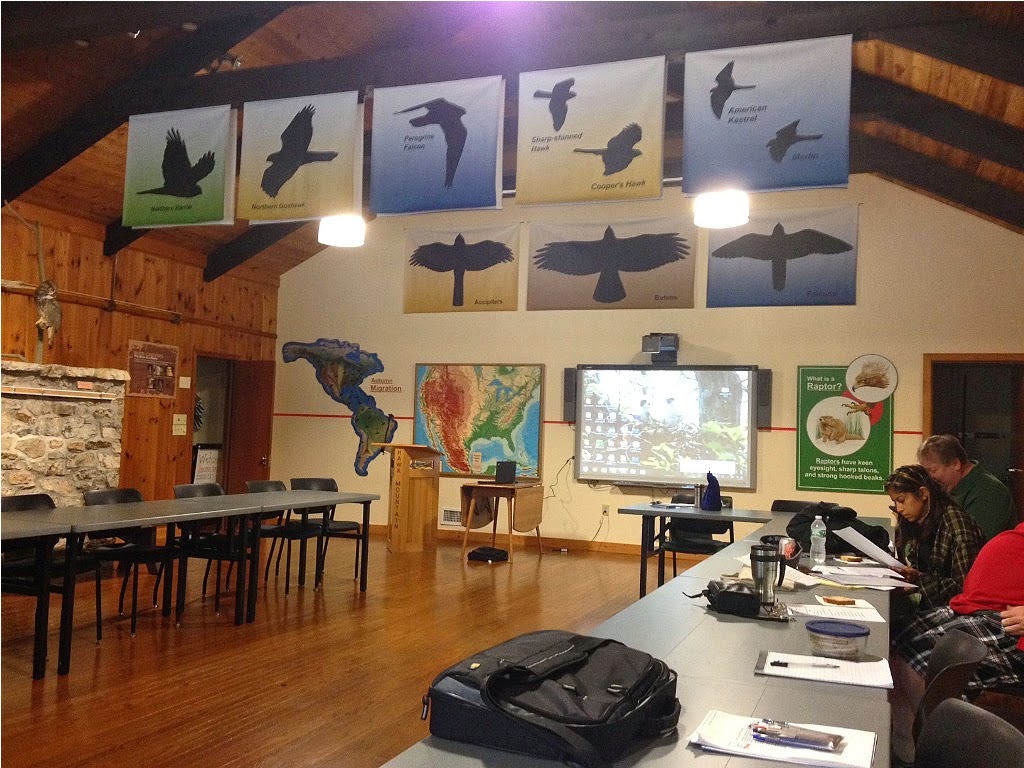
 Hawk Mountain's Common Room, now known as the Irma Broun-Kahn Education Building
I spent most of Saturday at Hawk Mountain, near Kempton PA, attending Laurie Goodrich’s annual Kittatinny Roundtable.  Laurie is Hawk Mountain's senior monitoring biologist.  The event brings together site leaders from hawkwatches in PA and NJ to discuss results from the previous season of raptor migration, hear about new research and generally give us something hawk-related to do in midsummer when migration really isn’t underway yet. (Yes, I know Waggoner’s Gap and a few other hawkwatches start their fall seasons in early August, but this past Saturday it was raining, so no one had any excuse for sitting on a hawkwatch).

This year the roundtable was held in the newly renovated Common Room.  The new Common Room also has a new name, the Irma Broun-Kahn Education Building, named after the wife of the sanctuary’s first curator.. The old Common Room was the site of educational programs for school kids and was used for volunteer parties and other events.  The new Common Room kept the lovely stone fireplace, the hardwood floor and the ceiling beams of the old one, but the rest is modernized and high-tech.

At our session on Saturday, we heard a talk about threats to the Jacks Mountain hawkwatch in Mifflin County from proposed wind farms.  The projects, which are still in the early stages, would likely end the watch there, as the proposed wind farms would likely level the top of the mountain by 100-300 feet in order to build a shelf on the knife-edged mountain for the wind turbines. More information about that is on the Facebook pages for the Friends of Jacks Mountain and SOAR (Save our Allegheny Ridges).  Jacks Mountain has upwards of 20 years of hawk count data in the national database, HawkCount.

We also heard the details of a Broad-winged Hawk nest study done at Hawk Mountain this spring where the young birds went from birth to fledging in 33 days and that the young birds were fed mostly short-tailed shrews and chipmunks, with one unidentified amphibian as their “baby food.”

The last presentation was from Dr. Michael May asking hawkwatchers to help the Xerces Society document dragonfly migration during our fall hawkwatches.  Dragonfly migration studies are so far not well documented, and Dr. May is interested in just about any information we can provide.  A sample data sheet has been developed, and using that sheet this fall is considered a pilot project to work out any “bugs” (pun intended) we may find with the process.