Long time readers of Roundtop Ruminations know that I love farmer lilies, and this year is an especially good year for them. They line the two-lane rural roads, often in groups of several hundred blooms. Travel another 100 feet and there’s another group of them that’s just as large, perhaps this time on the opposite side of the road. I easily pass thousands of them every day. I enjoy them no less because they are so common. Those huge, intense blooms are simply show-stoppers.
Yesterday was another day at adventure camp for me. We managed to get all the sessions in, though the last one was shortened a bit by an impending storm. The kids caught two green frogs, a minnow nearly large enough to qualify as a fish, a long-tailed salamander, water striders, assorted bugs - mostly helgramites - and the usual couple dozen crayfish that ranged in size from nearly microscopic to big enough to eat (we didn’t). The kids enjoy themselves and the activity and that’s what’s important.
That said, I was surprised by the low level of water in the little creek. True, it’s been a bit dry, but Roundtop has had its share of thunderstorms over the past few weeks that drop a quick inch or even two onto the ground. Right now the creek is as low as I would expect to be in August. I had another 1.5 inches of rain yesterday. I hope that helped. If not, the stream is going to be looking really bad when August actually does get here.
Friday, June 28, 2013
Wednesday, June 26, 2013
no cicadas, no noise
![]() |
| Farm lily in the morning |
Insects seem to be the only living things that don’t appear to notice the heat. They still buzz around the cabin, oblivious to the heat. Although much of southern PA is currently dealing with 17-year cicadas, Roundtop is not one of the areas where they are active this year. My county of York is not due to have them reappear here until 2021. Many people call them 17-year locusts, but officially they are the periodic cicada. They appear in either a 13-year or a 17-year cycle, living exclusively underground for all but two weeks of the 17 years. Once out, they shed their skins and become adults. They mate, the females lay eggs and then adults disappear. The eggs hatch before summer is over and then the nymphs disappear into the ground, living on plant roots for the next 17 years. Dog loved to eat them, pulling them off the trunks of small trees and gobbling them down like candy.
In the short time the adults live above ground, the males “sing” loudly. It’s not an unpleasant sound, perhaps somewhat eerie, but during the time they are out, the sound is loud enough to impede conversation in a normal tone, even if a person is standing next to you. It’s a relief when the singing season is over the forest returns to its usual sounds.
But as Roundtop is one of the cicada-free zones this summer, my midday sounds are few and not very loud. A slight breeze through the leaves is the only sound and that is one I never tire of enjoying.
Tuesday, June 25, 2013
Summer insects
The dreaded three H’s—hazy, hot and humid—have taken up residence on Roundtop. By my reckoning, they have already worn out their welcome. I’m the kind of person who would be willing to put up with 90 degree temperatures if they lasted just one day out of the year. As we have already passed that milestone this summer, I am now officially ready for winter to begin again.
I understand that I am probably in the minority with that desire, at least in this area. Although Pennsylvania usually boasts a full four seasons, most residents seem to prefer the hotter ones. Of course, I live at a ski resort, so I know I’m not the only person who likes cold weather. We may be in the minority, but at least I’m not a minority of one.
Hot weather comes with more insects, the good kind and the not-good kind. Specifically, I’m thinking of lightning bugs and mosquitoes. Who doesn’t love lightning bugs? When I was a kid one of the joys of a summer evening at grandma’s were our nightly expeditions out in the yard, armed with a jelly jar with holes poked into the lid. While the grownups chatted inside or on the front porch, all the kids and cousins roamed the yard catching lightning bugs, seeing who could capture the most. This year, I have plenty of lightning bugs around the cabin, though most of them seem to be in the upper reaches of the forest canopy. I’d have a tough time catching many of them. Is this because I live in the woods or have lightning bugs decided they prefer a higher altitude these days?
Mosquitoes are not a well-loved insect, with good reason. I have about 8 good reasons why I don’t like them scattered on my legs right now. I know that bats love them, and I like bats, so I try to be tolerant, but it’s a tolerance accompanied by gritted teeth.
Monday, June 24, 2013
Summer ramblings
Summer has only just officially arrived, though to my eye it already looks midsummer-ish. Leaves have changed from the bright, neon green of spring to the deep emerald green of summer. All the vegetation is thick and lush, and none of it has yet taken on that August shade of brownish green.
That nursing raccoon has returned. Last evening she appeared on my front deck at 7:45 p.m., when the chickens were still out. The chickens were on the other side of the cabin, a full half hour from going to roost, but at that time of the day they are usually foraging near the pen. As far as I know, neither raccoon nor chickens knew the other was nearby, but I am taking no chances. The chickens are in lockdown again, or so I hope. They love to be out of their pen, scratching around the forest, and anytime I open the pen door, even if only to replenish food or water, they rush the gate, thinking they are about to be let out. Have you ever tried to juggle 6 chickens? That’s what trying to keep them inside is like.
Doodle the rooster isn’t tame enough to catch. One of the chickens, dubbed Dumbbell, isn’t catchable either, and worse, she doesn’t seem to know how to go into the pen unless she follows one of the other chickens. I can have the door propped open and she will walk past it every time. The others are easier to catch, but they aren’t usually the ones first out of the pen, so I don’t usually have to deal with them.
The raccoon, and for that matter the chickens, are after the outside cat food. I currently have a wild momma cat and a small kitten that I’m trying to get tame enough to live trap. So far they are like quicksilver and very wary of the live trap. There’s also one of last year’s kittens still around, but only rarely. I’ve given up trying to catch him.
Never a dull moment. Sometimes I’d like to have a few dull moments, just to see what it feels like.
That nursing raccoon has returned. Last evening she appeared on my front deck at 7:45 p.m., when the chickens were still out. The chickens were on the other side of the cabin, a full half hour from going to roost, but at that time of the day they are usually foraging near the pen. As far as I know, neither raccoon nor chickens knew the other was nearby, but I am taking no chances. The chickens are in lockdown again, or so I hope. They love to be out of their pen, scratching around the forest, and anytime I open the pen door, even if only to replenish food or water, they rush the gate, thinking they are about to be let out. Have you ever tried to juggle 6 chickens? That’s what trying to keep them inside is like.
Doodle the rooster isn’t tame enough to catch. One of the chickens, dubbed Dumbbell, isn’t catchable either, and worse, she doesn’t seem to know how to go into the pen unless she follows one of the other chickens. I can have the door propped open and she will walk past it every time. The others are easier to catch, but they aren’t usually the ones first out of the pen, so I don’t usually have to deal with them.
The raccoon, and for that matter the chickens, are after the outside cat food. I currently have a wild momma cat and a small kitten that I’m trying to get tame enough to live trap. So far they are like quicksilver and very wary of the live trap. There’s also one of last year’s kittens still around, but only rarely. I’ve given up trying to catch him.
Never a dull moment. Sometimes I’d like to have a few dull moments, just to see what it feels like.
Friday, June 21, 2013
A day at camp
Weather cooperated and even produced a gorgeous day on Thursday, so I got to spend the day down at a little stream letting kids catch crayfish, frogs, salamanders and minnows. The kids had a blast and caught quite a haul. Dozens of crayfish were caught, most small to medium-sized, including the smallest crayfish I’d ever seen. The tiny thing was only a shy half an inch long. The biggest was about 3.5 inches.
A pickerel frog was caught (pictured), as was a helgramite, two minnows and a small long-tailed salamander, the most common species the kids find. We have more nets this year, so nearly every kid gets to use a net and they didn’t as often have to work in pairs as in previous years. That might have contributed to the high count of crayfish that were caught. I do release some of the prisoners between each session of camp, so likely some of those caught were repeats.
The kids also found a huge spider sunning on a boulder in the center of that stream that served to keep the kids from venturing too far upstream. I believe it was one of the many species of wolf spiders. I am hobbling with my bad knee at the moment, so I wasn’t able to get close enough for a more positive ID. It was big, I know that. Usually I have trouble keeping the kids to the section of the stream where I can keep an eye on them, so the spider served as a good boundary guard for the afternoon.
I have given up trying to get the kids to be quiet as they walk the .75 mile from their base camp to the stream. They are too wound up, and even if they were quiet a group of 10-12 kids is probably in and of itself too many for them to see much wildlife as they walk. I can hear them coming for at least 100 yards before they arrive. To them, more space simply means they have to yell louder to make themselves heard.
When the kids are at the stream, bird calls stop, but the kids aren’t gone a minute before ovenbirds, phoebes and pewees are calling again. At least I get to hear the sounds of the forest in between the groups. A few minutes of birdsong makes for a restful interlude before the next group arrives.
Tuesday, June 18, 2013
At the corner of summer
![]() |
| Common mullein |
The blooms appear slowly on the cone stalk, rising from the bottom to eventually reach the top of the cone. By the time the blooms reach the top, the stalk will be at its full height. I always thought it would be pretty spectacular if the entire cone was blooming at the same time, but mullein doesn’t work that way. Several rows bloom at the same time, but the lower rows are done by the time the blooms appear higher on the cone. So a few rows of small yellow flowers blooming at the same time is the way of this plant.
I saw my first snake of the summer on Sunday. It was a black snake, moving under a bush too quickly for me to even snap a photo with my phone camera. The chickens were nearby and either didn’t see it or didn’t care about it. I tried looking under the juniper bush, behind the juniper and around the juniper bush but never saw more than the back half of the snake. I’m guessing it was about a 4 ft. long snake, not one of the larger black snakes.
Generally, I don’t see many snakes here. I’ve seen water snakes, ribbon snakes, garter snakes and a milk snake, a few or several snakes a year. Black snakes are the most common. I wouldn’t be surprised to find out that a few copperheads are around, but I’ve never seen one here. I hope that continues, and especially I hope that continues during my sessions with the kids at camp. Last year a boy momentarily caught a brightly colored juvenile eastern water snake in his minnow net, and until it escaped and I got a good look at it (moving faster than any snake you could imagine), I wasn’t completely sure he hadn’t netted a copperhead. I was greatly relieved to see he had not.
Copperheads like rocky areas and wetland areas; a stone-covered stream bank would fall into their preferred habitat. When I’ve seen copperheads on hikes, they have been in rocky areas with no water nearby. But all land-based snakes will head down to streams in dry times, because that’s where dinner is likely to be found.
Monday, June 17, 2013
Spring passes, summer nears
Since big storms blew through last Thursday and cancelled my camp session, the weather has been gorgeous. Low humidity, big puffy cumulus clouds, a slight and welcome breeze—I couldn’t ask for more pleasant weather. And the good news is that the weather is supposed to continue this week, especially on Thursday when I shouldn’t have a weather problem to dampen camp.
I haven’t been down to the little stream for a few weeks. I did travel down sometime in April. At that point the weather was drier than is typical. Since then it’s been rainier than is normal, which will mean wet and muddy walking and a muddy stream. I don’t mind getting muddy myself, and I sure don’t mind getting the kids muddy, but if the stream is too muddy, the kids won’t be able to see crayfish or the other stream denizens. So I hope the mud in the stream will be mostly clear by then.
``````
I’ve been rereading H.D. Thoreau’s journals, my favorite of his writings. This time I’m reading a journal entry per day, matching his days with the same day here on Roundtop. Today, he’s complaining about haze and humidity at his place and notes that “The season of hope and promise is past.” Even further north, where he lived, spring has passed and is replaced with summer. In spring, all things seem possible again. In summer reality sets in or at least returns after a time of spring ebullience. That’s how it seems to me right now. The projects that suddenly seemed do-able again after winter don’t get done on their own. In my case, most of them are still awaiting some effort on my part. I always run out of time or energy, and another weekend goes by with little improvement. Such is life, I guess. Even on the longest days of the year, there isn’t enough time to get everything done I’d like to get done. Chores and errands still need done. My day’s worth of energy only lasts so long. Time is a vicious mistress and waits for no one.
Wednesday, June 12, 2013
Thoughts on a wet morning
![]() |
| Honeysuckle on a wet morning |
Small groups of kids will hike down to a stream a bit less than a mile from the main camp. We will hop over vernal pools and get muddy and wet. We will catch crayfish and frogs, perhaps a turtle. Some will complain that the walk is “too long.” Some will be amazed at finding a crayfish. Some will jump right in and have caught several before their time is up. Some are more timid and will be content only to peer at the little lobsters that I keep in a bucket until we release them. If we catch a salamander or a millipede, I will show them how to let it walk across their hands.
These are all kids whose parents have the means to send them to camp for a week. Some will have traveled abroad or gone to the Grand Canyon, but I have yet to find any who know much about their own backyards or the forests near where they live. Most never get the opportunity to play outside on their own. It’s pretty sad, and it causes me no little amount of worry. I worry because their lack of knowledge of the natural world does not bode well for the stewardship of our planet when it is their turn at the helm.
We will be gone by then, those of us who grew up with our hands and feet in local streams, who haunted small patches of woods after school. The world will be theirs to do with as they will. It’s unlikely my efforts will make much difference in the long run, though it’s an effort I feel I must make regardless. To do nothing is to give up and surrender. And so I do what I can, trying to fan the flames of hope that perhaps it will make some difference to some child, on some day.
Tuesday, June 11, 2013
More than a little rain
The forest is greener than green and the cabin’s surrounds are muddy. Torrents of rain fell yesterday evening, a real gullywasher. This morning I carefully pick my way around the cabin and Roundtop, trying to avoid the worst of the mud. It’s the kind of morning where being squeamish isn’t going to do you any good. You will get muddy. It will get on your shoes and your pants. Even with boots. April showers in June indeed.
Baby Dog and I don’t wander far off a trail or a road, and still we come home muddy. Baby Dog does not like baths any better than she likes mud, so that makes for a struggle. The rain doesn’t seem to have slowed down the more feral residents of my mountain. I heard one of the red foxes barking not long before the deluge last night. The raccoon was still out and about, though as a nursing mother raccoon, she has mp choice. She has to be.
A rain-soaked deer sprang up in front of me by one of the snowmaking ponds, dashed across the road, paralleled my walking route, and then circled around, still at a full run, to get to the opposite side of the pond and head up the slopes. I see what I think is this same doe every morning, either by the pond or down on one of the dirt roads. I’m pretty sure she’s hiding a fawn somewhere nearby, so her big circle was designed to take her back towards wherever the little one was hidden. I have a rough idea where that is, down to within perhaps a hundred yards. I don’t feel the need to disturb the fawn just to see if I’m right.
More rain is in the forecast. We need it, as the area is still below where it should be for rainfall. But I’m not looking forward to more mud.
Baby Dog and I don’t wander far off a trail or a road, and still we come home muddy. Baby Dog does not like baths any better than she likes mud, so that makes for a struggle. The rain doesn’t seem to have slowed down the more feral residents of my mountain. I heard one of the red foxes barking not long before the deluge last night. The raccoon was still out and about, though as a nursing mother raccoon, she has mp choice. She has to be.
A rain-soaked deer sprang up in front of me by one of the snowmaking ponds, dashed across the road, paralleled my walking route, and then circled around, still at a full run, to get to the opposite side of the pond and head up the slopes. I see what I think is this same doe every morning, either by the pond or down on one of the dirt roads. I’m pretty sure she’s hiding a fawn somewhere nearby, so her big circle was designed to take her back towards wherever the little one was hidden. I have a rough idea where that is, down to within perhaps a hundred yards. I don’t feel the need to disturb the fawn just to see if I’m right.
More rain is in the forecast. We need it, as the area is still below where it should be for rainfall. But I’m not looking forward to more mud.
Monday, June 10, 2013
In spring are already signs of decay
Spring is still mostly in full bloom, with bright green foliage and a seemingly unending and ever-changing supply of flowers. And yet, some flowers are already done blooming and have moved into the next step in their life cycle. The sight of this flower was a reminder to me that even in spring blooms end. It's not just in fall that plants finish up their business for the year and prepare to close shop for winter.
Spring's early-bloomers have already developed seed pods or hips, the “fruit” part of the flower. I’ve also discovered that while I can identify a fair number of flowers when they are blooming, once those blooms fade, so does my identification skill.
Are these the hips of dame’s rocket, of wild pink? Perhaps something else? I don’t know the answer, and for that I blame my flower ID books. They show all kinds of flowers in bloom, but have virtually no information about how those same plants look after they are done blooming. Perhaps it’s the birdwatcher in me who knows birds have multiple plumages depending on their age and gender, and I expect to find photos of each of those in my bird books. So why are wildflower books only about the flowers and not the rest of the plant, before and after the blooms? Aren’t those “plumages” too?
So I am unable to positively identify these flower fruits, today. The lack will bother me until I can figure it out—unless one of my gentle readers can provide an identification and save me from hours of research through a mind-numbing array of reference guides? Ah well, if not, you’ll simply have to wait until I can figure it out.
Spring's early-bloomers have already developed seed pods or hips, the “fruit” part of the flower. I’ve also discovered that while I can identify a fair number of flowers when they are blooming, once those blooms fade, so does my identification skill.
Are these the hips of dame’s rocket, of wild pink? Perhaps something else? I don’t know the answer, and for that I blame my flower ID books. They show all kinds of flowers in bloom, but have virtually no information about how those same plants look after they are done blooming. Perhaps it’s the birdwatcher in me who knows birds have multiple plumages depending on their age and gender, and I expect to find photos of each of those in my bird books. So why are wildflower books only about the flowers and not the rest of the plant, before and after the blooms? Aren’t those “plumages” too?
So I am unable to positively identify these flower fruits, today. The lack will bother me until I can figure it out—unless one of my gentle readers can provide an identification and save me from hours of research through a mind-numbing array of reference guides? Ah well, if not, you’ll simply have to wait until I can figure it out.
Friday, June 07, 2013
April showers in June and...
April showers are falling in June this year. Technically speaking, the rain is from the fallout of Tropical Storm Andrea. Mostly, it’s been a fairly gentle rain, and I haven’t seen anything more intense than a moderate rain. Without good spring rains Roundtop has been rather dry, and an inch or two of rain is much appreciated and much needed.
So this morning fog shrouded the mountain, and water dripped from every surface. As I am more than 3 inches below normal for rainfall, the ground should well be able to soak up an inch or two of rain. This storm likely won’t bring anything more dramatic than that to Roundtop.
Outside work around the cabin will have to wait until the weather clears, making the upcoming weekend a good time to cook a few dog biscuits, catch up on reading Richard Crossley’s new raptor guide and to try and decide what model of “lady’s” chainsaw I want to buy. I need a small one that’s light enough for me to handle to do some minor jobs around the cabin. Small branches, the odd dead sapling or monkey vines litter the area and so could use a clean-up.
Sometimes small saplings don’t die and threaten to turn into small trees in spots where I don’t need one. The American beech are especially prone to this. I have three large trees of that species around by cabin, and the “children” pop up all the time. Usually, they die on their own, succumbing to lack of light or water. Usually, I just wait for them to disappear on their own. But sometimes they don’t disappear and then spring rolls around and they are growing somewhere that overhangs the driveway or perhaps they got crushed beyond repair by the FedEx truck but somehow still didn’t die. So I have things to get cleaned up around the cabin. And for things above a certain size, I need a chainsaw.
I don’t plan to take down trees of any size, just things in the range where something more than loppers are needed but not things requiring a lumberjack. But first, I have to decide which chainsaws to look at and then I need to go heft a few of those to figure out which one I want. And then I have to save the money to buy one. So, the buying won’t happen this week or probably not even next week.
Maybe, if I get really bored or desperate, I’ll even do some much needed cabin cleaning. Or, maybe not. Chainsaw research is more important.
Wednesday, June 05, 2013
Not a field of grain
Spring slides into summer, and a choppy slide it is. A little here, a little there, a back slide for a few days. At the moment Roundtop is in a back slide towards the spring we never quite had. The nights are cool, the days take until noon to warm up. It’s comfortable weather, with long June evenings. I can appreciate the long hours of daylight in weather like this. The skies are not yet fully dark even at 9:30 p.m.
But when the temperature journeys and stays into summer’s heat and haze, the long hours of daylight becomes something simply to endure. Then, I wait for sunset and the relief from the heat that usually brings. But not today. Today, I can enjoy the long evenings
This morning on my walk with Baby Dog, I discovered a patch of carpet moss. From close-up the female moss structures look like a field of ripening grain. When conditions are dry, the moss capsules open and release the spores. The weather has been dry for spring here, but I don’t know if it is dry enough for the capsules to open. Even if it’s dry enough for them to think about releasing the spores, a hard rain is predicted for the tomorrow and the weekend, so the moss might change its plans.
Baby Dog isn’t much interested in moss, especially when she just spied a deer slipping back into the cover of the woods. Moss doesn’t move, deer do. Enough said.
Tuesday, June 04, 2013
Thank you
![]() |
| Oxeye daisy |
Baby Dog and I are finding the cabin rather quiet and empty right now. Baby Dog no longer has to bark impatiently while she waits for me to bring Dog back into the cabin after a walk. She is strangely quiet and only an invading raccoon or a fearsome deer makes her break silence.
Dog was 12 and diagnosed with cancer in January. I’ve known since then that this time would come, though I can’t say that knowledge made the end any easier. He had good days and bad days and was pretty good through the Memorial Day weekend. He began to seriously decline the Tuesday after the holiday and by Friday I knew this time he would not bounce back.
On our last day together we shared some ice cream, a treat he had been denied for a while because of the special diet he needed in his last months, and then went to see some cows—a favorite activity for him.
Baby Dog and I both miss him.
Monday, June 03, 2013
Thursday, May 30, 2013
Trouble returns
Look who’s back! Or perhaps it’s a different raccoon than the last of the trio of terrorists that killed two of my chickens at winter’s end. After months of not feeding birds as a result of the robbers, I wanted to get rid of the last of some shelled peanuts. Blue jays love shelled peanuts, and with a brood of jays in an oak tree at the edge of my deck, I thought I’d be nice and provide some food for the parents to ease their burden of caring for the nestlings. You can see how well that idea worked.
The peanuts were out just 24 hours before being found by a raccoon. With Baby Dog howling in rage in the background, I went to the door, waving my hands to shoo the raccoon. She did decamp, peanut in mouth, only to return moments later. This raccoon is a nursing female, no doubt thrilled to find such an easy meal.
In the meantime, my chickens are on lockdown again, and those girls are not in the least bit happy about that. It’s always something.
The peanuts were out just 24 hours before being found by a raccoon. With Baby Dog howling in rage in the background, I went to the door, waving my hands to shoo the raccoon. She did decamp, peanut in mouth, only to return moments later. This raccoon is a nursing female, no doubt thrilled to find such an easy meal.
In the meantime, my chickens are on lockdown again, and those girls are not in the least bit happy about that. It’s always something.
Wednesday, May 29, 2013
Birds amid the battle, the railroad cut
When people visit Gettysburg, especially if the trip is likely to be a one-time or rare event for them, they concentrate on just a few sites of the more famous spots around the town and the battlefield. Everyone wants to see Devil’s Den, the High Water Mark, where Pickett’s Charge began or the spot where Lincoln gave his address. And those are the most historically important sites. For me, who is fortunate enough to be able to visit Gettysburg often, the lesser-known sites are every bit as interesting.
On this trip I visited the alms house area, where fighting took place on the first day of the battle. The old alms house itself, a place for the “feeble-minded and insane,” was a terrible place for those kept there but was also the site of a battlefield hospital after the fighting more to the south of town. Many monuments dot the side of the road that winds through this area, and one of the battlefields more unusual monuments commemorates the 90th Pennsylvania Infantry.
The monument depicts an oak tree shattered by artillery fire. The story goes that artillery fire struck and brought down branches of the tree and with it a robin’s nest. Inside the nest were several babies, shaken by their fall but unharmed. One of the soldiers, under heavy fire and at no little risk to himself, picked up the nest, climbed the stump and replaced the nest.
When the monument to the 90th Pennsylvania was designed, the idea was to celebrate a new life amid the battle and to hope that the end of the Civil War would bring a new era of peace and goodwill.
Further on, I visited the old railroad cut, the site of more heavy fighting on the first day of the battle. At the time of the battle, the cut was excavated but railroad tracks not yet laid. Several hundred died here in heavy fighting. Most were Union troops, many from the 147th New York who did not receive the first order to retreat from the cut. After the Confederate troops took control of the cut and the surrounding high ground, Union troops regrouped and attacked again, this time, retaking the area and forcing the surrender of about 300 Confederate troops.
I had never before walked the railroad cut, though that has always been something I wanted to do. The last time I visited, I was deterred by rain. This time, the rain had just ended, though the sky remained overcast. Along the way I found several small, much weathered red, white and blue ribbons, made into bows and placed on rocks in the cut. Not many people get out of their vehicles and walk the railroad tracks, though obviously, someone had.
Tuesday, May 28, 2013
Memorials and Monuments
![]() |
| Soldiers National Monument - view of a soldier and the figure "History." Two other figures, "Peace" and "Plenty" adorn the opposite side of the monument and Liberty is atop the obelisk. |
I live near Gettysburg, Pennsylvania, and have visited the battlefield there hundreds of time in my life. First, I went with my parents. Visiting Gettysburg was our family’s preferred way of spending a Sunday afternoon. I played in Devil's Den from the time I was allowed to run around on my own, and we usually picnicked somewhere on the battlefield. Now, I visit on my own. Gettysburg is crowded in any season of the year but never more so than in the summer. This year the town and battlefield will likely be even more crowded than usual, as 2013 marks the 150th anniversary of the battle.
There’s a lot to see in Gettysburg and though I’ve been there so often, I still don’t think I’ve seen everything, and some things I haven’t seen in quite a while. Every time I make a trip here, I try to visit a spot that I haven’t visited in a while or some place where I haven’t spent as much time as I’d like. This time, befitting Memorial Day, one of my primary stops was the national cemetery, where President Lincoln gave his famous address.
It’s been quite a while since I walked in the cemetery, and I’d forgotten some important things about it. Perhaps the first thing I noticed was that soldiers from other wars are buried here too. I saw graves from both WWI and WWWII, and if soldiers from more recent wars are buried here, I didn’t see them. Two graves from WWII, side by side, were noteworthy. The death date for the grave on the right is December 7, 1941 and the grave on the left is June 30, 1945. Those two deaths mark the start and nearly the end of that conflict.
The other thing I’d forgotten was just how many graves of the unknown there are here. Nearly half of the Civil War soldiers buried here are unnamed. Sometimes the graves are marked Union or Confederate unknown, sometimes the name of the unit is printed on the gravestone, sometimes the state where the soldiers came from is marked but mostly the graves are simply Unknown. Hundreds of graves, perhaps even more, are marked this way.
On a stone from Maine, marking 104 bodies, was a small homemade wreath made of dried pine needles and a note, which reads, “To the brave sons of the Pine Tree State who gallantly fought and died here so long ago. You are not forgotten by the students of Riley School, Rockport, Maine.”
Tomorrow: I'll share photos from another part of my afternoon.
Wednesday, May 22, 2013
Both vultures practice vulturing
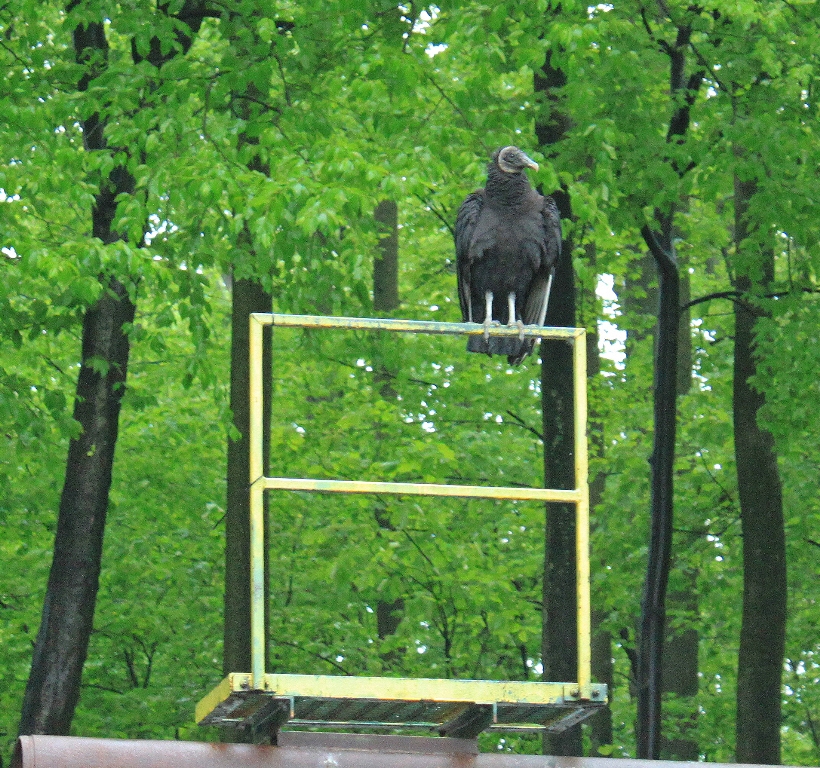
The air was so thick and heavy yesterday that even the vultures were brought to ground. Instead, both black and turkey vultures hung out around Roundtop’s dumpsters. Perhaps they figured that since they were grounded, they might as well hang out where they could still find some pickings. Or hoped to.
The black vultures seem less shy and slower to leave a food source than are the turkey vultures. The turkey vultures hopped over to the roof of the nearby maintenance building as soon as I pulled up to their dumpsters. The black vultures didn’t budge when I got out of the car and closed the door and only deigned to move when I got within several feet of them.
![]() |
| Black vulture (bottom) and turkey vulture (top) |
The black vultures seem less shy and slower to leave a food source than are the turkey vultures. The turkey vultures hopped over to the roof of the nearby maintenance building as soon as I pulled up to their dumpsters. The black vultures didn’t budge when I got out of the car and closed the door and only deigned to move when I got within several feet of them.
![]() |
| Black vulture |
Black vultures are supposed to be a bit smaller than turkey vultures, but I can’t say that I notice that. They are much the same size as far as I can see. Lots of vultures ply the air around Roundtop, both kinds. They roost on or near the mountain on most nights. Once 20 of them roosted atop my cabin roof and the old TV antenna. I live only about 20 miles from Gettysburg, site of the famous battle, of course. There, witnesses told of masses of vultures for months after the battle, and to this day the battlefield boasts many, many vultures. Once the big birds found that spot, they didn’t want to leave, apparently. At this point, 150 years after the battle, I do have to wonder what keeps so many of them there. Perhaps that congregation of them contributes to the large numbers I have at Roundtop.
Tuesday, May 21, 2013
More newbies
New babies are sprouting up all over the place. Last evening I passed a herd of Thoroughbred mares with their new foals enjoying a warm evening in tall grass. The local Canada goslings that ply the ponds around Roundtop are already getting large. The first brood is already the size of my smaller chickens, albeit chickens without feathers.
I haven’t yet seen any new fawns, though I am still regularly seeing deer. Often, my sightings aren’t much more than eyes shining by the light of my headlamp. Last night Baby Dog and I heard and saw four deer, none of them small enough to be fawns. We walked out my driveway to reach a patch of open sky, so I could take a last look at the sky before heading back to the cabin. As I stood there I heard the rustle of motion in the forest on the other side of the lane. At first I only caught momentary glimpses as the deer moved down the hill towards me. I watched the glint of their eyes as they passed in front me and kept moving further down the mountain and through the forest. Sometimes the underbrush hid the eyeshine entirely, sometimes I could see them looking at me as they walked.
They thought they were invisible, of course, and except for the eyeshine, they were. Baby Dog listened intently, though I’m not sure she saw them any better than I did. The deer kept moving though at an unhurried pace. I suspect they were heading down to the pond for a drink. They usually wait until dark to come out of hiding and search for water. They are sneaky about it. I have rarely seen a deer at the pond. I think they aren’t there very long. They come down, slake their thirst and then immediately return to the safety and cover of the forest. Invisible again.
Monday, May 20, 2013
Weekend warblers (and a calf)
![]() |
| Calf investigating a tractor |
I’ve yet to see worm-eating, Wilson’s, orange-crowned and several others at the cabin. Black-throated green is usually common and Blackburnian isn’t unheard of. For several years black-throated blue was common, but I haven’t seen one of those lately.
The fog and drizzle of the weekend kept the skies gray or invisible most of the time. The warblers weren’t inclined to attempt to migrate through it. Instead, they spent the weekend around the cabin throughout most of the day. Birders typically get up early during warbler season to catch a glimpse of our little jewels. This weekend that wouldn’t have been necessary. The gloomy weather kept the birds around all day, even into the middle of the afternoon. They also didn’t seem to mind my presence very much. When I was outside I was moving around from one chore to the other and the birds weren’t fearful or shy. I wondered if the calm presence of my chickens outside their pen and foraging made the warblers feel safe enough to ignore me.
![]() |
| "Can I have the keys?" |
I did hear a yellow-billed cuckoo this weekend, which is always a treat. The bird never seems close to the cabin, but the sound of that odd call travels a longer distance than do most. Sometimes the bird sounded as though it was high up on the mountain. Sometimes it sounded down along the lower slope, but never did it sound close enough to attempt to look for it. I had to content myself with listening to its haunting call. Maybe one day that call will be close enough to the cabin to make it worthwhile to attempt to find the bird.
Subscribe to:
Posts (Atom)


