Tuesday, February 16, 2016

Snow - ice - sleet - rain

For the moment, the forest is snow covered. I say for the moment because I am in the middle of one of those snow/sleet/ice/rain storms that is a staple of southern Pennsylvania winters.   Even for here, this storm is extreme.  Yesterday morning was 4° and today the temperature will be in the 40’s! Yesterday I was dripping the faucets to prevent the water pipes from freezing, and today I am worried about flooding!
The feeder birds are feeding heavily. I still haven’t seen anything unusual here so far this winter, unless you count a sapsucker as unusual, which I don’t.  Not a siskin, not a redpoll, not a purple finch can be found.  The winter finch forecast was not encouraging, but it didn’t sound as though I’d have none of them, just fewer.

So “today’s” photo was actually taken on Sunday, when the snow was still lovely and not icy or water-logged. It may be the last photo of nice-looking snow for a while.  I took the photo from the kitchen of my family’s farmhouse, looking over to South Mountain. I never get tired of this view.  The mountains look different nearly every day of the year.

Wednesday, February 10, 2016

Snow, beautiful snow!


Isn’t it amazing how snow can transform the look of a landscape?  Even though I’ve lived at the cabin for more than 20 years now, the forest around me looks like an entirely different place when it’s covered with snow.  Yes, I know all about the downside of snow—the constant shoveling, the dicey driving, the sore muscles that follow the constant shoveling.  And yet, looking at the forest covered in snow never fails to inspire me.  I wish more of the year was snow-covered.
So far this winter, I’ve had a few days with just a trace of snow—that’s not really enough to make me appreciate it.  Then I had the 31” storm that was nearly melted a week later.  Now, I’ve added another 6-7 inches of snow-cover.  This one is likely to stay on the ground for a while, as temperatures are to plummet for the next 4-5 days. 

Unlike the blizzard, which was as powdery and lightweight as a feather, this was a heavier snow that even in a rather stiff breeze is sticking to the trees, which only adds to the beauty of the winter forest.

Wednesday, February 03, 2016

Before the rain

I took this snow photo on Tuesday morning, before the clouds rolled in.  At the moment it is raining (!) and raining hard, with fog to boot.  It’s the kind of day for me to stay inside and work around the cabin. I’d say the weather isn’t fit for woman or beast, but the bests don’t mind the heavy, cold, near-freezing raindrops soaking their coats as much as I do.

My plan for the day is to do some housework, peppered with a little cooking and a couple of cups of hot chocolate or flavored coffee.  It’s a ham and bean soup kind of day, too, though any good, hearty, hot soup would do as well. It's a good excuse to spend a few hours watching the feeder birds, too, even if it's only the "usual suspects" that are frequenting them this year.

Monday, February 01, 2016

Out of the blizzard!

I’ve been quite lax recently in keeping up with Roundtop Ruminations, and for that I apologize and will try to do better.  Lately, I’ve been taking photos and posting them on Facebook, mostly due to a lack of time. Feel free to friend me there, if you like (Carolyn Hoffman).  Those photos go up pretty much as soon as I take them, though often with a cellphone, as that is more quickly at hand, especially when I am walking the dogs.
Most of this past week has been spent shoveling 31” of snow that fell during the blizzard of 2016.  With help from Roundtop Mountain Resort, I now have my car dug out in and in my driveway.  Plus, the sibling, sibling-in-law and I have also gotten the farm’s driveway plowed out and dug out, at least as much as it’s going to get done.
The chickens have gotten over the shock of seeing so much snow, but still haven’t found their way clear to lay me any eggs.  I hope that changes soon! I can’t say I blame them, though.
Around the cabin, I’ve been seeing deer and turkey. They have been using the plowed driveways and walk paths for their own travel, as that is much easier than wading through so much snow, though doing so brings them closer to people.  They don’t appear to mind this. Somewhat to my surprise, the Carolina wrens are still around.  After a big snow in 1993 or 1996 they disappeared for several years.  Those little southern birds like to roost and nest under tree roots and similar ground tangles.  In heavy snows they are buried and can suffocate or starve.  But in this snow the birds were out and about the day after the blizzard, so they made it through this time well enough.

My feeders have been busy with birds—nothing rare this winter—though I have had some local birds that don’t normally appear in my feeders show up demanding food. The blue jays have been out in force, as have a pair of crows.  I think this is the first time I’ve had the crows in the bird feeders.  Naturally, these large birds empty the feeders faster than the little ones.  One of my errands today will be replenishing the bird seed.  I am nearly out, and the birds are counting on me!

Monday, January 18, 2016

Feeder birds, 1; weather forecaster, 0

Ominous morning clouds over Pinchot Lake
My feeder birds are better at predicting snow than the local forecasters.  Two days ago I wasn’t supposed to get any precipitation when I noticed the feeder birds chowing down in earnest.  That’s never a good sign.  It’s true they weren’t going at the bird seed like little demons, but the level of feeding was definitely higher than was normal for 10 a.m.  The clouds looked ominous, and snow wasn’t far to the south of me.  Perhaps it was just nearness of that coastal storm that set them off.  But no.
Within an hour, the first snowflakes appeared, and not long after that the snow was heavy enough that I couldn’t see the mountain to the west and before long I couldn’t even see to the bottom of Roundtop.  For an hour or so, the snow was pretty intense before it began to taper off.  The feeder birds do not lie.  They know when it’s going to snow.  They are not fooled.
This winter, I don’t have any exotic or unusual feeder birds, just the usual suspects in roughly the same numbers as is typical.  For me, this means about 5 Carolina chickadees, a pair of Northern Cardinals, 2-3 tufted titmice, a pair of Carolina wrens, another of eastern nuthatch, the ubiquitous downy woodpecker and an array of dark-eyed juncos that never seem to quite understand how feeders work.  They are much more likely to just sit around and watch the other birds eat from the feeders. Eventually, they return to the ground where they join the white-throated sparrows.
 I also have a few infrequent visitors—a pair of house finch and another of American goldfinch, the red-bellied woodpecker and occasionally the hairy woodpecker taps on the tree from which the bird feeders hang.  I have yet to see that one in the bird feeders.  I have no sign of pine siskins, let along the even more rare evening grosbeak or the rarer still, redpoll.

Still, I do not complain as watching these little ones flit in and out never gets old for me.  They teach me a lot about the behaviors of the different species, and, as weather forecasters go, they can’t be beat.

Wednesday, January 13, 2016

Snow finally arrives


Finally, Roundtop sees a measurable snow, if barely.  The snow blew through at dusk yesterday, accompanied by a vicious wind that made me glad I was inside the cabin in front of the fireplace.  Today, the wind is abating and no longer howls, but at 12 degrees, it doesn’t take much wind to feel bitter cold.
Today, all the birds are feeding heavily, emptying several of my feeders before noon.  And that’s without help from the chickens, who remained in their coop, unwilling to emerge, until after noon.  The wild birds don’t have that option, of course.  The number of them at the feeders today is causing an unusual amount of disagreements.  The white-breasted nuthatch don’t like each other and when they are not feeding, they are trying to chase each other away.  The juncos have something against both the titmice and chickadees and will force both of those species from the platform.  They simply don’t want to share.  For the first time I’ve had 5 Carolina chickadees at the feeders at the same time.  Until today I thought I only had 4 regular visitors. 

Oddly, even in this cold I’ve seen a few robins this morning, though one was sitting in the middle of the road as I drove off the mountain and only flew reluctantly.  Still, their cousins, the eastern bluebirds were singing this morning, so they are apparently getting by well enough.  It does, finally, feel (very much so) like winter, but after the warmth in December, it’s well past time for the season to appear in earnest.


Friday, January 08, 2016

How long will it last?


This photo was taken on December 23, and I’m posting it for one reason only.  This tree looks as though it will fall before long, and I wanted to document how long it would be before that happened.  I’m not sure when this tree began to lean so precipitously, but it hasn’t been that long.
 I walk by this spot every day with the dogs, and I do try to make a habit of noticing things.  I might have missed seeing it lean for a few days, as I couldn’t see this far into the forest due to heavy fog or because I was walking when it was still mostly dark, but I doubt I missed it for longer than that.  Even now, I’m not so sure that the only things keeping it from falling aren’t the medium-sized boulders at its base.  And no, I probably won’t get much closer than this to investigate.

The tree is leaning from south to north, so a southerly wind might well do it in, though southerly winds are mostly blocked at this spot by the mountain that rises behind the tree.  Still, it won’t take much to bring it down—a moderate ice storm, a heavier rain, perhaps even a heavy snow.  I just want to see how long it takes between when I took the photo and when the tree actually falls.

Wednesday, January 06, 2016

Re-learning how to do winter

Ahh, the never ending fog has finally cleared, leaving chilly winter days and bright blue skies.  I love winter’s light near sunset here on the mountain.  Everything turns a lovely, warm golden shade, one last warmth of the sun before night’s fall.
I have discovered after the never-ending autumn that I am out of practice for my winter routine.  I have to remember to change the chicken’s water twice a day, leaving the frozen container to thaw in my bathtub.  I try giving the chickens extra straw for warmth, but they usually end up kicking it out of their coop.  I’ve never understood why. 
I spent an awful amount of time looking for my winter gloves and my boot cleats.  Fall lasted through the end of December this year, unlike last year when winter kicked in by mid-November.  One thing I’ve always enjoyed about living in Pennsylvania is that I could say it has four distinct seasons, usually evenly split.  Not this year, not unless winter lasts into April, which seems unlikely, if not impossible.
My bird feeders are seeing more action, finally.  I have yet to see any unusual species this winter, but even now I’m still hearing migrating geese and have yet to see many waterfowl.  The birds that summer in the north have been as slow to head south as I have been to remember what needs to be done during my winter days. I hope we all get it right before long. 

Monday, December 28, 2015

Geese finally heading south


Note:  This photo was taken yesterday. Today is not foggy, though it's still overcast and the light isn't good so far, for photos today.

I should have known something was up when I counted 71 Canada geese on Roundtop's largest pond this morning around dawn.  The usual count is about 35-38.  And the local geese didn't seem too happy to be sharing the space with the new interlopers.

Since then, and even now as I type this, I hear the sound of Canada geese far overhead.  Occasionally I see a flock, hundreds of birds to each one.  This is the first time I was sure the geese I was seeing were migrants.  They are only two months late.

I have suspected that a couple of the flocks I'd seen throughout November were migrants but I wasn't entirely sure. Migrating geese are noisy, usually honking the entire time they fly, and except when they are taking off or landing, they usually fly quite high.  Sometimes the geese I saw in November were honking like migrants, but they weren't particularly high or there weren't many in a flock.  I thought it was possible they were birds up off the Susquehanna River rather than long-distance flyers.  But not today.  These birds, so far multiple flocks of them, are heading south in full cry.

No doubt the first blast of semi-wintry weather that's just a few hours away from falling here is the cause.  The precipitation will fall as sleet this time, and the weather maps show it edging ever closer to Roundtop.  So those geese that have been languishing in the warm northeastern weather have finally decided it's time to move south to avoid the wintry weather.  It's about time.  Past time.  A lot past time.

Wednesday, December 23, 2015

Have a foggy, foggy Christmas


 Wait!  That’s not how the song goes.
 
And this is not how Christmas is supposed to look, either.  But here it is.  Foggy and warm enough to sit out on the porch, if you don’t mind a little drizzle. 
Foxtail with raindrops, like a miniature Christmas tree with bulbs
I’m already tired of El Nino, which shows no sign of let-up or allowing winter to return to normal.  I want cold and snow, though it’s hard to argue about the lack of a heating bill.  Still, this is not the kind of weather that makes me want to put a warm, winter stew over the fire.  It’s not even good hot chocolate weather.
What it is, is about as foggy as it can possibly be.  These photos were taken shortly before noon today, not at dawn or dusk or even first thing in the morning when fog is usually thickest.  No, this is noontime fog.  It’s the kind of fog that makes me glad I don’t have 100 miles of driving ahead of me today.  A quick trip down the mountain and into town at 35 mph is about as exciting as I want it to be.  And 35 mph is about the only safe speed today, which makes me glad I’m not on an interstate somewhere.

Fog for Christmas is a new thing for me, I think.  At least I don’t remember any other year with fog, let alone fog like this.  So now I am back in my cabin, where I plan to stay for the rest of the day, cooking up the last batch of Christmas cookies and hoping that Christmas day will bring something other than more fog. 
I hope all of you and yours have a very, Merry Christmas and a great holiday!

Monday, December 21, 2015

Hemlocks--still here but under assault

Holiday preparations clearly are affecting both my writing and photographic time this week.  I love Christmas, but I am ready for the event itself and for the preparations for the event to end.  I hope that once the holiday is over, my days will return to normal, so I can spend more time writing and taking photos again.
The photo today was not taken at my cabin but in Michaux State Forest.  This is, I believe, a little feeder stream into Tom’s Run.  It’s already been a week since I was there and I’m only now downloading the photos.  One thing I noticed on my walk that day was that live hemlocks, Pennsylvania’s state tree, can still be found in abundance.
The state’s trees are under assault by something called the wooly adelgid, which sucks fluid from the base of the hemlock needles, eventually killing the tree.  They look a lot like wooly aphids that can infect houseplants.  Like so many other devastating pests, this one is not native to North America.  It came from Japan, and our native hemlocks have no immunity against it.  And like wooly aphids, the pest can be killed with a soap/oil mixture.  Unfortunately, the preventative needs to be applied at least once a year, not to mention just how does one spray all the hemlock trees in a forest? 
Currently, the pest is found in 56 of Pennsylvania’s 67 counties.  They can kill a tree in 4-10 years without treatment.  The state is moving ahead with the soap/oil treatment and is apparently thinking about introducing a beetle that can kill the adelgid.  This worries me, as I can only hope the beetle doesn’t end up causing other problems, as so often happens.  The beetles are expensive, too, I’m told.
The hemlock is a foundation tree in our forests. A healthy tree supports many other animal and insect species.  Clearly, a forest without hemlocks would not support the same species as a forest with hemlocks.  A forest without hemlocks would be an entirely different ecosystem. 
On my walk, I did see some dead hemlocks—most looked to have been dead for years and may well not have died from this pest.  The other hemlocks I saw still appeared healthy, at least for the moment. I hope they stay healthy.  I can’t imagine a Pennsylvania forest without them. 

Tuesday, December 15, 2015

No ice, no snow, open water

Sunrise over Pincho Lake - December 13, 2015
Non-winter is in place here on Roundtop Mtn.  The ski resort hasn’t yet been able to make snow, as the nighttime temperatures are well above freezing.  I haven’t turned on the electric heat in the cabin, though on a few damp mornings, I had a fire in the fireplace.  For the past week I haven’t even needed that.
Birds are not flocking to my feeders.  They are apparently still able to find natural food in the forest.  Oh, a few of them show up in the morning and again in the evening. I think it’s more to check that food is available than from any real sense of needing it.  By this time turkey and black vultures have usually departed at least some ways to the south.  Yesterday, I saw 9 of them twirling around the top of Roundtop. 
El Nino, the apparent cause of this warm weather, is showing its impact.  How long this record-breaking, strange weather will last is unknown.
Today, a northwest wind is driving down the temperature, though it’s still above 50°.  The northern robins, a Labrador subspecies I believe, still forage through the forest.  When I was younger, they were called woods robins locally, browner and larger than the summer robins that breed here in that season.  I saw a flock of 14 yesterday.  I usually find them by sound.  They tend to hang together in a loose flock, skimming through the forest.  I see them mostly in the mornings and evenings.  Most winters I see them into January, though they do disappear during the worst of a winter.  In February they often reappear on the first sunny day. They are always able to find open water—perhaps from a spring-fed pond, a puddle or an open stream.  So far this year, the pickings are easy and open water is everwhere.

Wednesday, December 09, 2015

Returning to Camp Michaux

On Monday, I decided to return to a spot I hadn’t visited all year.  Michaux State Forest is about a 17 mile drive between mountains with lots of hiking trails and a couple of state parks, lakes, reservoirs and lots of hemlock and white pine.  It’s mostly undeveloped forest, with some cabins in areas that are not on state forest land.  I love the smell of the pines, especially in winter or what’s passing for winter so far this December.
Stone, moss-covered steps in foreground.  Site of Zwingli cabin between the two trees
One thing I wanted to do was revisit the site of the camp that I attended as a 'tween and young teenager.  Camp Michaux was first a CCC (Civilian Conservation Corps) camp and then a POW camp during WWII and lastly a church camp from 1946-1972.  Sometime not long after the camp closed, they removed all the buildings, which hadn’t changed since the CCC days—wooden clapboard barracks with metal bunk beds, an outdoor shower area (discretely fenced), a dining hall and a swimming pool.
I'm in the second row, second girl on the right (white headband)
So it has been about 40 years since the camp was occupied, and it’s amazing how quickly the forest has reclaimed the area.  The two-lane paved road that was the main entrance to the camp is now covered with pine needles, branches, a few small downed trees, and the macadam is only visible as a narrow path down the center.  The stone steps down to the cabins are filled with more pine needles and seem more like natural rocks than steps.  Even the stone block foundations are barely visible anymore.
Main "road" into camp. Macadam now mostly invisible
I walked down what used to be the main camp road and found the spot where the cabin that I stayed in used to be.  Nothing looks particularly familiar anymore, and I am rather happy about that.  I’m surprised that the reclamation is happening so quickly.  I’m happy that the forest is taking over what was originally its own.  At this rate, in another 20 years or so, even the little I found that remained will be gone, and nothing will remain but the forest. 


Wednesday, December 02, 2015

Hunkered down

 It’s hard to take photos in a heavy rain, which is why you haven’t seen many blog posts from me, now that I am mostly recovered from a hard cold.  The rain is accompanied by low clouds and fog, so the lighting is terrible.  Sunrise is now at 7:11 a.m., and with the rain and overcast skies, the chickens do not arise for a good 30 minutes after the sun’s alleged rise.
If I’m lucky, I can find enough light around noon to snap a quick shot, but they are nothing to write home about.  The wet darkens the tree trunks, which would be a nice effect if the lighting was cooperative, which it isn’t.
Pennsylvania’s rifle deer season started on Saturday, so traipsing around in the woods, even if the weather was cooperative, is not the thing to do right now.  I heard a lot of gunfire the first 30 minutes of the season, far less later in the day, and not more than 1-2 shots since then.  The deer are hunkered down, as much from the rain as the hunters.  Most of the hunters I’ve seen are waiting for the weather to improve before resuming their hunts.  My own family hunters reported not seeing a thing even though we routinely see three buck promenade across the grassy boulevard that leads down to our pond our at the farm.
Here on Roundtop, I saw the old doe this morning.  She lives in a narrow band of forest between my cabin and my neighbor’s cabin.  She is used to hearing the squealing of my neighbor’s elementary-aged girls and the barking of my dogs.  When flushed by one or the other of us, she just crosses the lane and finds another spot a few feet away.  I hope she makes it through doe season in another week or two.  I like having her around, though she is an old doe who didn’t produce a fawn this season.  I like watching her.  She is about half-tame, whether from habituation to us or because her age makes her less inclined to bolt like a youngster.  She would be tough-eating for a hunter.  I am torn between wanting her around and thinking that perhaps a quick shot would be kinder than a long and painful decline from age in a harsh winter.

Friday, November 27, 2015

Old rock, "new" rock


My apologies for the lack of posts.  I’ve been harboring a cold and have done little except wrap myself in a blanket and drink gallons of hot tea.  I am over the worst of it now and so am beginning to venture out again, if not venturing very far just yet. 
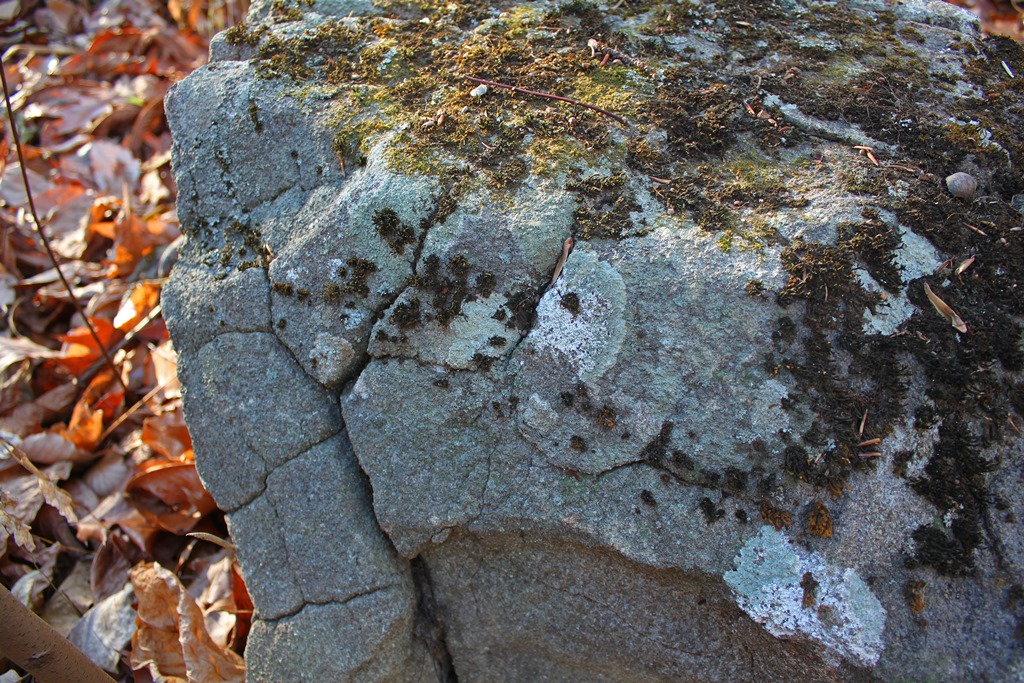
 An advantage of not being able to venture too far is that I am looking more closely again at the forest around my cabin.  Today, the boulders that line the lane and my own front forest caught my attention.  In summer the rocks are nearly hidden by annual growth, and it’s only in the leafless seasons that I can see them well.
The weathered and cracked boulders are the most typical of the rocks here.  These are desk-sized rocks that have been exposed to the elements for who knows how many years.  Exposure to ice and rain are doing their best to break them into the smaller rocks that are even more numerous all around on the forest floor.  These little rocks were former boulders, still working their way down in size into ever smaller rocks. The boulders are home to moss and lichens, too.  Sometimes a small fern, usually a Christmas fern, manages to find enough of a foothold to grow in one of the cracks.
And then I have what I call the “new” rocks.  They are not new in the sense of overall age. Likely, they are as old as any of the other rocks around the mountain.  But they are newly exposed to the elements and so are not yet cracked and worn or split into small pieces. 
These rocks were exposed less than 50 years ago, when the lane up the mountain was first built.  My lane is not the first road up the mountain, and it may have even been created from an older, narrower road that ended at a sadly gone log cabin. (I was fortunate enough to see that abandoned cabin in the first years I lived here, before it was damaged by a large tree and then vandalized by late night partyers.) Today, these newly exposed rocks line the lane.  They are smooth and bright, usually square-ish.  Weather has not yet taken its toll on them and won’t for who knows how many more years.  But now that they are exposed to sunlight and rain, that slow destruction will begin.  None of us will see that, of course, and perhaps humans won’t even be around the earth anymore when that happens.  But it will happen.  Time is patient.

Wednesday, November 18, 2015

Embracing the dreariness

I am enjoying a dreary November day.  It is a bit foggy and overcast, so the day is dark.  The air is still and the trees are bare.  It’s chilly.  I had a fire in the fireplace this morning and may need one again before long.  For now, I am wrapped comfortably in a wool sweater, my hands warmed by a cup of hot chocolate.  This is how November should be.  At least it’s what I think of when I think of November. 

Novembers should be chilly and raw, not sunny and bright like an October afternoon.  So in an odd way, the dreariness makes me happy. Today feels like a normal November day, dreariness and all.

Thursday, November 12, 2015

Dark and dreary


It was so dark and dreary this morning that I was late getting up.  I kept waiting for some semblance of daylight to appear, and it never did.  A black cloud hung heavily over the mountain, so even at 7 a.m. I needed a headlamp for a little while, and Doodle the rooster didn’t crow until almost 7:30 a.m.
The rain, while not heavy, was cold and the breeze blew little slivers of it onto my face, stinging it.  Even the Shelties were happy to turn around and head back to the cabin this morning and that has to be a first!  Birds were hunkered down in whatever shelter they could find, but a great horned owl was still calling just before 8 a.m. 
By afternoon, the day improved, and the sky soon filled with turkey vultures and a pair of red-tailed hawks.  The little birds came out of hiding too.  It is, after all, November and this is how November is supposed to be.  Or even colder, though it’s still sort of early enough in the month to let that pass for now.  Here on my mountain, November is a transition month.  It can be a leaf-less repeat of October, or it can be winter.  So far, this November is milder than average, but with the coldest part of the month still ahead, it’s too soon to complain about just how mild it’s going to be.

Instead, on this chilly and blustery morning, the dogs got a bit of a walk.  When we returned to the cabin, we had a fire in the fireplace, and I had a cup of hot chocolate, and that was enough to scare away the chill. 

Monday, November 09, 2015

Early morning frost


Roundtop has had both frosts and freezes this fall, but this morning was the first hard frost where I could get a photo.  Even though the temperature was a chilly 27 for a few minutes this morning, as soon as the sun rose above the horizon, the warmup began.  Now, just 3 hours after the early morning frost, the temperature is already up to 50, and the frost is long gone. The photos are all that is left.
I like the shadow of the rising sun’s rays on the oak leaf.  You just know that frost will be gone momentarily.  The photo captures the coming warmth of the day in the sun shadows while still showing the result of a cool night. Most of the leaves are down now.  The few that are left are no longer even bronze but are more like a deep copper.  The color is not much different than the color of the bark of the trees, so the forest is nearly monochromatic today.  Even so, I find this a pretty time of year. The long vistas are back.  I can see the mountain to the west, the pond to the north.  I can even monitor the chickens’ whereabouts instead of just hearing their scratching.

I can see the sky again, and monitor the coming rain without having to leave the cabin to find a patch of open sky.  Already the air has a chill, nearly raw feel to it.  I was forced to clear as many leaves off the decks that I can, to avoid a sodden mess when the rain comes.  Likely, my work will only be partly successful, as more leaves are already coming down.  I hope the most of them are removed, but one good wind gust before the rain will be enough to negate my work. 

Thursday, November 05, 2015

November's forest light


The first few days of November have been atypically warm, more like mid-October than the blustery weather that is more expected.  I find it hard to complain much about 70 degree weather and gorgeous late fall light.  The fall colors that remain have faded from brilliant yellows and reds into shades of bronze, but the mountains are still beautiful.
The leaves of summer now litter the forest floor, and it is impossible to walk quietly.  The leaves, as yet undampened, are as crunchy as crumpled paper and as light and airy as snowflakes.  The Shelties are belly-deep in leaves, and they are above ankle deep for me.  So it is difficult on this rare November day to grouse about temperatures so far above normal.  Instead, I simply enjoy the afternoon, marveling in the golden shades of light.
So many leaves are off the trees now that for the first time, I can see the mountain to the west of me, though it is not yet as clear a view as I will have when all the leaves are down.  I can see partway down the mountain, now, and the porchlight from across the valley bobs in and out of view at night with every slight breeze.
The sweet little fawns of summer have no clue about the winter ahead or the fall hunting seasons.  They stand still as I drive by, Baby Dog hanging out a rear window staring at them.  But she doesn’t bark and the now spotless fawns don’t flee.  A few birds of summer remain or perhaps they are birds that nested much further north than here that have now reached this area in their flight south.  A palm warbler, about the same color as its surroundings, pops up among a host of goldfinch, juncos and song sparrows.  We stare at each other for a second or two and then it is off.  I hope the warm weather is an aid to its southbound journey and that its travels are safe. 

Monday, November 02, 2015

Leaves falling down


This is the week of leaves falling down at Roundtop.  Leaves are everywhere, floating down like rain and crunchy underfoot.  So far no rain has dampened them or turned them into a sodden mess, the first step of decaying into new forest soil.

For the first time since May I can see the outline of Nell’s Hill to the west.  I can not yet see the porch light of my nearest western neighbor, who lives a mile or so down the mountain, across the narrow valley, across Beaver Creek, over the swampy area and starting up the next mountain.  When I can see those lights, I’ll know winter is approaching and that all the leaves are down.

So far this season, I have seen little signs of waterfowl migration.  I would have expected that to have started by now, but not even migrating geese have been spotted.  The local geese honk and fly over on their nightly rounds, pretending or perhaps thinking about migrating.  The instincts are there for them, even if they don’t head south.  A quick trip to Pinchot Lake this weekend saw it empty of any waterfowl, except for seven geese.  Those were certainly local birds, too.  Migration is late, perhaps a result of the warmer weather this week.
So this past weekend was a very nice one for the time of year, a tad warmer than it’s been and with no rain.  The photos with today’s post were all taken this weekend.  You can see that the brilliant falls colors are gone.  The leaves are not yet faded into all browns, but the drama of the season is past. It was a good time for enjoying the weather.  Not many more days this year can I expect the weather to be so balmy or so conducive to outdoor work.  I’ll take these lovely fall days however I find them.